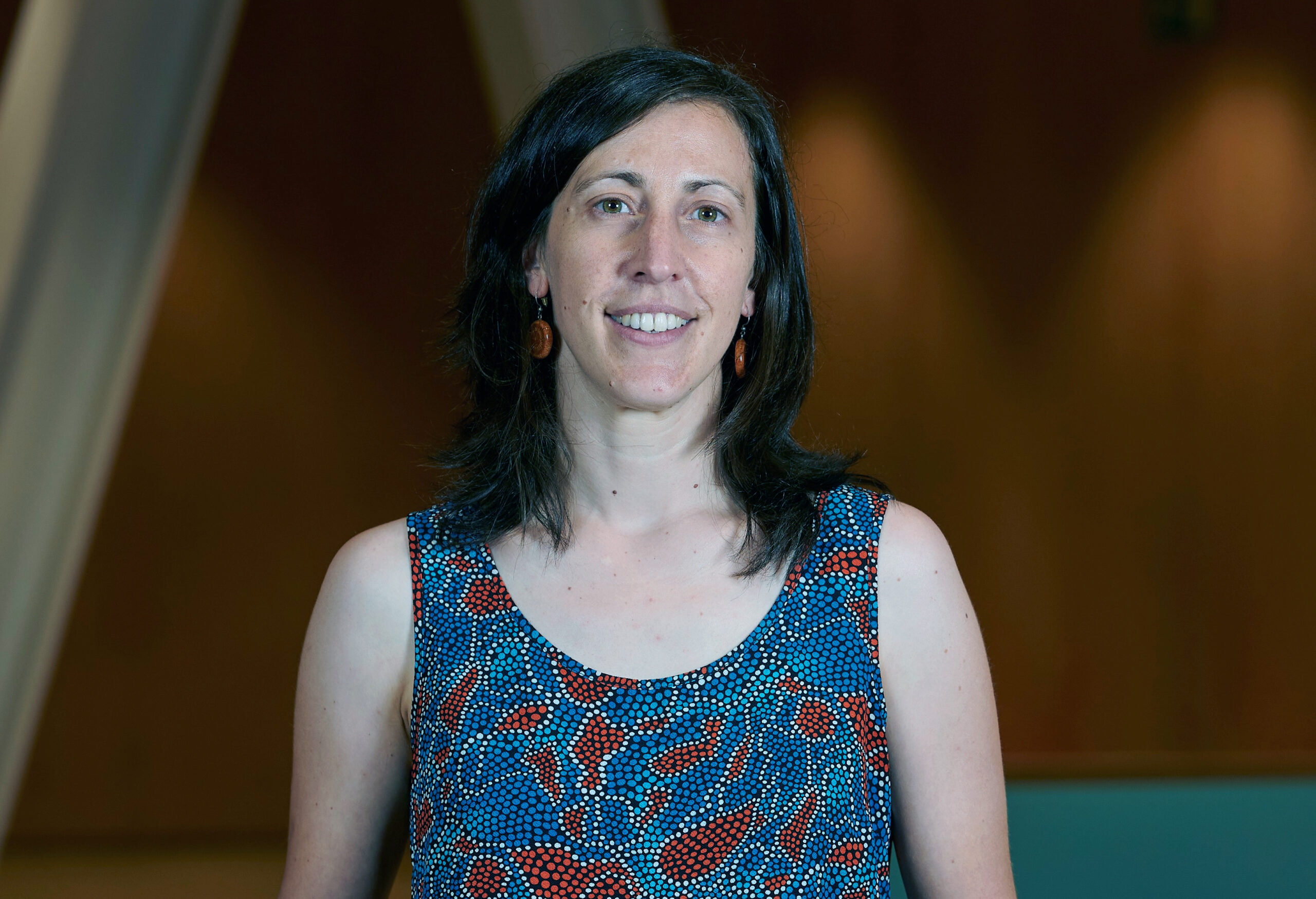
For the fifth consecutive year, Mireia Gascon, a researcher at the Central Catalonia Research Support Unit (USR) of IDIAPJGol and the Catalan Institute of Health (ICS), has appeared on the exclusive Clarivate Analytics list, which includes the top 1% of the most highly cited authors among publications indexed in the Web of Science database. This year, Gascon also appears on the list of the most highly cited researchers compiled by Scilit, an aggregated database managed by the publisher MDPI that brings together information from PubMed, Crossref and DataCite.
The 42-year-old IDIAPJGol researcher is a biologist specialising in environmental epidemiology. After graduating, she completed a Master’s degree in Toxicology and Environmental Health at Utrecht University, where she had the opportunity to take part in a study in Costa Rica on the impact of the sugar industry on workers’ health. Back in Catalonia, she completed her PhD at the Centre for Research in Environmental Epidemiology (CREAL), now the Barcelona Institute for Global Health (ISGlobal), with a thesis on chemical pollutants and immune and respiratory health in children. As a postdoctoral researcher, Gascon continued at ISGlobal along the same research line, focusing on the impact of air pollution on human health. She was awarded a Miguel Servet grant to study the gut microbiota and its role in the association between environmental exposure and children’s neurodevelopment.
She is currently a member of IDIAPJGol’s Health Promotion in Rural Areas (PROSAARU) research group, where she has launched a new research line on planetary health. The aim is to apply “the findings to clinical practice and to the training of primary care professionals, because, just as flu waves put pressure on healthcare systems, increasingly so do heatwaves, for example”. In this context, Gascon believes that, in the current climate crisis, “professionals need to incorporate planetary health into their work”.
Congratulations once again on being one of the world’s most highly cited researchers. What does this recognition mean to you?
The world of research is very complicated, and establishing yourself and surviving in it is difficult, so this kind of recognition is gratifying. Not only because it has an impact on your CV, but also because it shows that the research I do is of interest. The most important thing for me is that the results of my work have an impact. It also reflects the fact that I have chosen a topic that people are interested in.
Your research focuses on environmental epidemiology, on the relationship between the environment and people’s health. What led you to become interested in this field?
My father recommended Rachel Carson’s book Silent Spring to me, and I immediately became passionate about the subject. I wanted to do my upper secondary school research project on the impact of the Rubí stream, where I am from, which was very polluted at the time, on men’s reproductive health. However, at school they told me that it was not possible, so I ended up doing a project on the parallels between the stories in the Tintin comics and historical events. I studied biology because I wasn’t really sure what I wanted to do, and while doing an Erasmus in the Netherlands, I discovered environmental epidemiology, a field of research that I have never left.
What projects are you currently working on?
My research has always been largely based on birth cohorts, and until now I have focused more on the impact of air pollution and green spaces — what is known as the urbanome — specifically on children’s neurodevelopment in urban environments. This is a line of research that I am now bringing to an end. Within this field, I became interested in understanding how these exposures can affect children’s microbiota, including antibiotic resistance.
We have now started a new project called RESISTANCE, which is a new birth cohort in the Osona area aimed at understanding the environmental impacts occurring there. A great deal of research has been carried out in urban areas, but rural areas have not been studied as extensively. With this project, we want to find out whether intensive livestock farming can have an impact on the presence of antibiotic resistance genes in pregnant women and their babies, based on the hypothesis that livestock farming, through its emissions, may be contributing to the presence of resistance genes in air samples. We are not looking at other samples, such as water or soil, due to budgetary constraints.
What results are you obtaining from this project?
As we have only just started, we do not have any results yet, although we have conducted a pilot study to test the equipment we intend to use and detected resistance genes in the air. This confirms findings from previous studies carried out elsewhere.
More generally, what is the situation in Catalonia regarding the impact of antibiotics used in livestock farming on human health?
In Europe, these practices are highly regulated and the use of antibiotics in livestock farming has been significantly restricted. The problem may arise when large numbers of animals are concentrated in a particular area. Another issue is what happens with meat coming from outside the European Union, from China or other countries that do not have the restrictions we have here, and which can transmit antibiotic resistance through consumption. When deciding which meat or other food products to import, we should take these factors into account.
What is the situation regarding pollution? Are things better now than they were a few years ago?
In the Barcelona Metropolitan Area, air quality has improved overall. Road traffic remains the most important factor, accounting for around 50% of air pollution. Aviation and shipping are also important, although to a lesser extent. In Osona, in addition to road traffic, livestock farming has an impact on pollution, as does the burning of fuel to heat homes, including the burning of pellets and firewood. Depending on the area, emphasis needs to be placed on one source of pollution or another.
What about children? Are they better protected now? Are things improving?
I don’t think we are going backwards. We are increasingly able to detect certain pollutants that were not previously monitored. For example, persistent organic pollutants such as DDT, a pesticide that was widely used a few years ago, were banned after it was found that they had an impact on human health and bioaccumulated. In recent years, new compounds and emerging pollutants have appeared and have been incorporated into industry, such as BPA and phthalates. For some of these, we still do not know exactly what impact they will have on health. Nevertheless, there is greater awareness and a greater capacity to respond to new pollutants. They are increasingly being studied, and we are able to protect people earlier.
How does pollution affect our health, specifically that of children and pregnant women?
Air pollution, for example, has an impact in many different ways. It is associated with problems in children’s neurodevelopment and with the risk of lung cancer in non-smokers, and it increases the risk of stroke, diabetes and even dementia. We have seen that ultrafine particles can reach the brain through the bloodstream, and this has an impact on children’s neurodevelopment as well as on the risk of dementia in adults. Persistent organic pollutants and other non-persistent chemicals are endocrine disruptors and have an impact at hormonal level, which is associated with some cancers, as well as reproductive problems and problems in children’s development.
It is becoming increasingly difficult to conduct research without collaborating with other teams. What networks and collaborations are involved in your research projects?
Research cannot be done without collaboration. It is essential. Research is like a swarm of bees, in which each part makes different contributions. Another professional’s perspective complements your own. For example, I am an environmental epidemiologist, but I carried out the project on air pollution and children’s neurodevelopment with a team of psychologists from Sant Joan de Déu Hospital. We have both national and international collaborations. We work with national and European researchers who have extensive expertise in characterising environmental exposure.
The RESISTANCE project is possible thanks to our collaboration with the Vic Hospital Consortium and IRIS-CC, which have expertise in microbiology; with IRTA, which helps us with environmental measurements and the detection of antibiotic resistance genes; and with ISGlobal, which provides geographic information systems that allow us to geolocate participants and farms and link the results. Without all these different areas of expertise, it would be impossible to carry out the research I do.