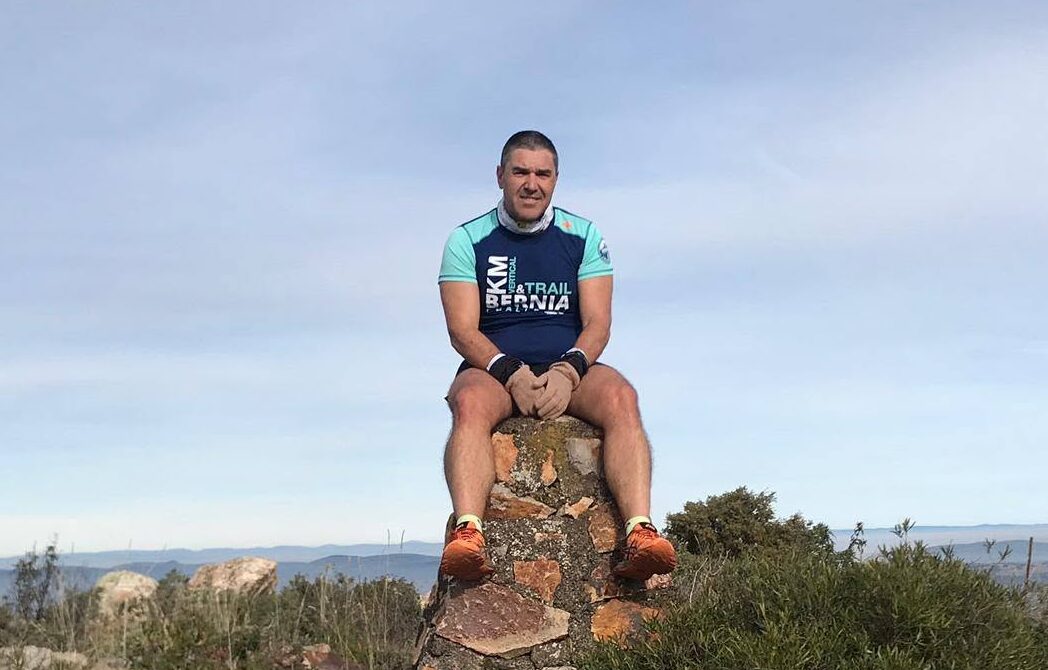
Pepe Fernández is a mathematician by training and a statistician at the Research Support Unit (USR) for the Terres de l’Ebre region, part of IDIAPJGol. He arrived in the area from Alicante following a job offer and has since built a solid professional career. He is currently involved in primary care research projects and teaches at Rovira i Virgili University. Outside of his professional life, he is also deeply engaged in sports: he is an ultramarathon runner, has completed several Ironman events, and helped found two sports clubs.
Fernández was born in Puertollano (Ciudad Real) and studied mathematics at a time when statistics did not exist as a standalone degree program; consequently, he later specialized in this field. From the outset, he knew he wanted to pursue research, though he did not yet know in which specific area his career would unfold. “Many of my peers studied mathematics with the intention of teaching or working in banking. I wanted to do research,” he recalls.
A contract linked to a project at the University of Alicante brought him to that city, where he completed a master’s degree and, subsequently, a doctorate in public health, focusing on epidemiology. However, the economic climate at the time made it difficult to continue his professional path. It was then that he applied for a position on a project in the Terres de l’Ebre region; two days after his interview, he was already in Tortosa. “It was quite a struggle to find the right opportunity, but in the end, I found what I was looking for—and I’ve stayed,” he summarizes.
His involvement with the USR began with a specific project, where he worked as a database analyst; over time, he gradually began collaborating on other studies initiated by local healthcare professionals. This experience allowed him to broaden his expertise and gain familiarity with the research needs within primary care.
Initially, his work consisted primarily of analyzing databases and addressing the needs of principal investigators; however, over the years, his involvement has grown, encompassing various phases of the studies. Fernández argues that a statistician should be part of a project from the moment it is first conceived, rather than being brought in only after the data has already been collected. “It is essential for the statistician to be involved in the project almost from the very beginning,” he asserts. Understanding the research objectives and methodology from the outset allows for proper planning of data collection, the structuring of databases, and the anticipation of requirements for subsequent analysis. “If we start from the data collection stage, the analysis process becomes much easier,” he maintains.
This level of involvement across different study phases has also presented him with professional challenges that remain particularly memorable. One project that left a significant mark on him was a study on atrial fibrillation and oral anticoagulants, led by Rosa Dalmau. This project allowed him to deepen his knowledge of the medical field to better understand the research, while also taking on tasks related to the management and organization of data from SIDIAP. “I was used to being handed a prepared database and simply performing the analysis; in this project, I also had to act as a data manager.” Another notable project stemmed from a proposal to develop prediction models for influenza epidemics, using an approach similar to that used for weather forecasting. The idea excited him from the very start and eventually culminated in a doctoral thesis by Elizabeth Castro.
He is currently participating in the Fibrilex project—spearheaded by the GAVINA research group—an initiative focused more on innovation than on statistics. Fernández attends project meetings that also include technical staff from SIDIAP with expertise in IT. The team is currently working to secure funding.
Pepe Fernández is a professor at the URV Faculty of Nursing, where he teaches Biostatistics during the first semester of the first year, and Research Methodology during the second. He also supervises undergraduate and master’s final projects, as well as doctoral theses.
He describes his relationship with teaching as a “love-hate” affair. To characterize it, he borrows a phrase from his best friend in Tortosa, suggesting that the key lies in finding the right dosage. “I think that, in teaching, I have just the right dose to be happy. I wouldn’t want to be a ‘professor’ [in the sense of a full-time academic career], but I do enjoy teaching classes,” he explains.
His other major pursuit is sports. He began running during his first year of university in Madrid, at the suggestion of a flatmate. “Running is addictive: you start, you feel good, and because you feel good, you keep running.” Together with that same friend, he founded the ‘Corricollano’ club in Puertollano. Over the years, he moved from marathons to ultra-distance events, and later to trail running. His athletic background includes some of the most demanding mountain and endurance races, such as Ultra Pirineu, Ultravulcania, and the Marathon des Sables—a 250-kilometer race across the Moroccan desert.
Later on, he ventured into the world of triathlon. During his time in Alicante, he founded the ‘Apolana’ club, which organizes events ranging from sprint-distance races to full Ironmans, and also runs an athletics school for children and adults. He has personally completed several Ironman events, which combine swimming, cycling, and running. Nowadays, his approach to sports is less competitively intense: he runs, swims, and cycles, and often, at the end of the workday, he heads to the gym to take part in group exercise classes with the same regular group.
Outside of sports, he devotes some of his free time to reading—primarily novels, though he also takes an interest in certain non-fiction essays. He doesn’t have a television, and when he wants to watch a movie, he prefers to do so on his computer.
Having dedicated years to research, Fernández believes that one of the key lessons he has learned along the way is the necessity of staying up to date. “You have to invest a great deal in your own education, and you have to enjoy studying,” he states. The statistician explains that research demands a constant updating of one’s knowledge and an attitude of continuous learning. Furthermore, he considers it essential to surround oneself with people who possess knowledge and experience—even those with more expertise than one’s own. In this regard, he advocates for separating professional relationships from personal ones, and for valuing an individual’s capabilities over personal affinities. He believes that working with highly skilled professionals offers an opportunity to learn and improve, regardless of any differences in personality that may exist. For Fernández, the ability to distinguish between one’s work, the individual, and one’s personal life is also a key factor in building strong professional relationships.