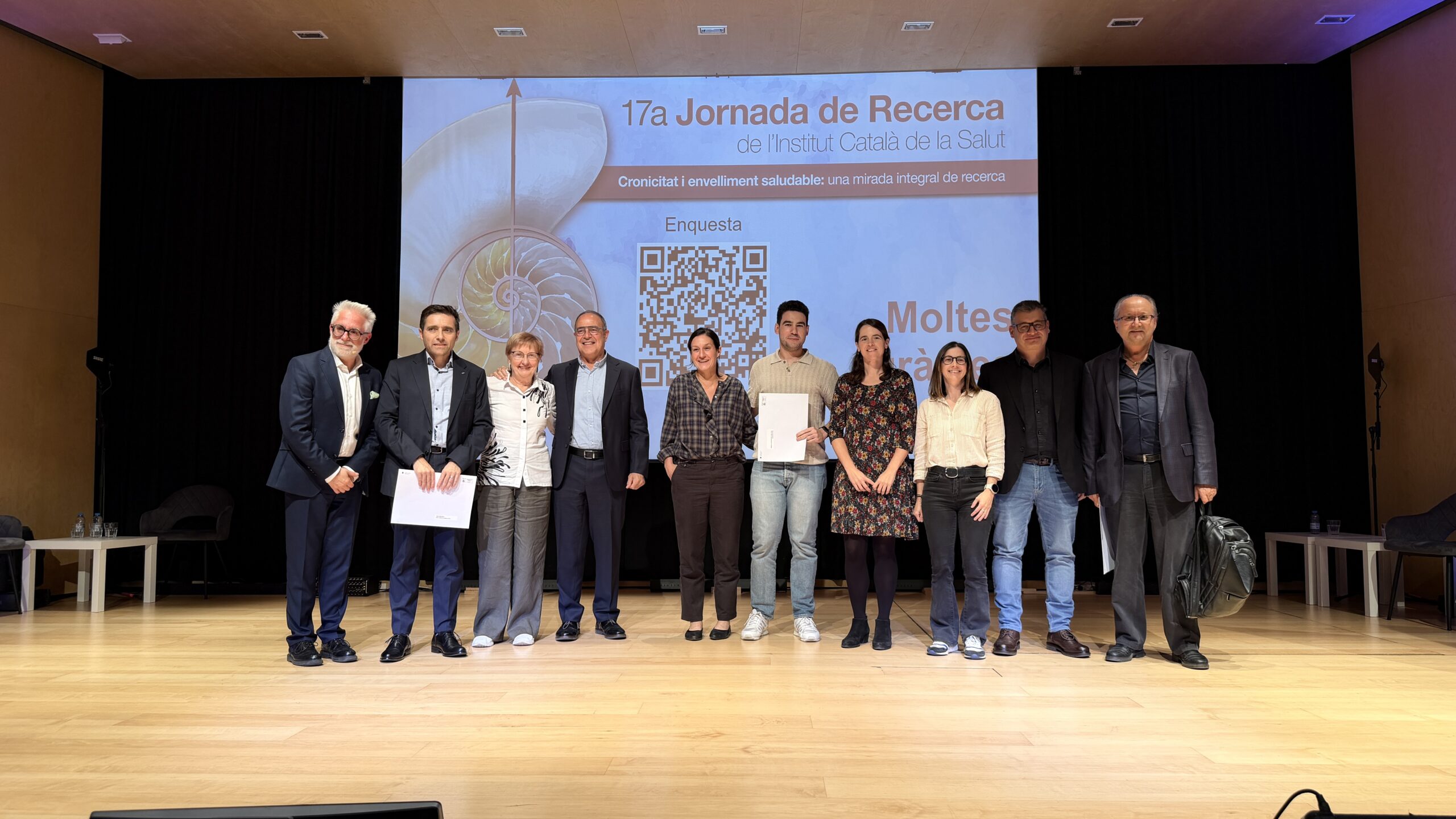
Healthy ageing and chronic conditions took centre stage at the 17th Research Conference of the Catalan Health Institute (ICS), held on 28 October 2026 at the ONCE Auditorium in Barcelona. This year’s event was co-organised by IDIAPJGol.
The conference was opened by the Managing Director of the ICS, Josep M. Pomar; the Deputy Director-General for Health Research and Innovation at the Catalan Ministry of Health, Montserrat Llavayol; and the Director of IDIAPJGol, Josep Basora.
Pomar argued that research is not a complementary activity to healthcare delivery, but an essential part of healthcare practice. During his presentation, the ICS Managing Director outlined the main research and innovation indicators of the research centres affiliated with the institution, including 9,500 professionals involved in research and innovation activities, more than 5,000 clinical trials and 673 competitively funded projects. Scientific output exceeded 6,000 publications in indexed journals, and 152 clinical practice guidelines were produced.
Llavayol highlighted the commitment of the Ministry of Health and the Catalan Government to research as a strategic priority, while Basora emphasised the fundamental role of Primary Care in generating knowledge that helps improve people’s lives. The Director of IDIAPJGol also highlighted the Institute’s improving research results.
From diseases to personal trajectories
In the opening lecture, Isabel del Cura, Coordinator of the Research Unit of the Madrid Primary Care Management Directorate and a member of IDIAPJGol’s External Scientific Committee, addressed chronic conditions from a holistic perspective. She stressed the need to move from “explaining diseases to understanding personal trajectories”. The researcher advocated an approach that considers how conditions evolve over time and how they affect each individual differently.
Del Cura emphasised the importance of considering individual variability and the social inequalities that shape people’s experiences of chronic illness. She also advocated a comprehensive understanding of chronic conditions that incorporates mental health as a cross-cutting dimension, inviting participants to rethink what we mean by chronic disease.
In this regard, she pointed out that having data does not necessarily mean having knowledge: data must be interpreted and contextualised to better understand people’s needs and guide healthcare interventions.
These reflections were further explored during a round-table discussion moderated by Rafa Simó, Head of the Diabetes and Metabolism Research Group at the Vall d’Hebron Research Institute (VHIR). The speakers discussed the importance of a comprehensive and coordinated approach between primary and hospital care in addressing non-communicable diseases, including cardiovascular conditions, kidney disease and cancer.
Ageing with independence and quality of life
Healthy ageing and frailty were the focus of another presentation, delivered by Itziar Vergara, Scientific Director of the Biogipuzkoa Health Research Institute and also a member of IDIAPJGol’s External Scientific Committee. She highlighted the relationship between ageing and chronic diseases and advocated transforming the way the healthcare system responds to older people’s needs.
Vergara stressed the importance of incorporating innovative and transformative ideas, emphasising that healthcare and research professionals must maintain an open-minded approach to identifying the real needs of older people, without perpetuating stereotypes or discrimination.
“As healthcare and research professionals, we have a responsibility to remain open-minded in identifying the real needs of older people, avoiding discriminatory attitudes such as ageism or gender bias when analysing and responding to these needs,” she stated.
This was followed by a round-table discussion on ageing research, moderated by Francisco Martín, Dean of the Faculty of Medicine and Health Sciences at Rovira i Virgili University, Head of IDIAPJGol’s Healthcare Interventions and Community Activities (ISAC) Research Group and the Lifestyle and Disease Prevention Group at IRBCatSud. The discussion centred on a key question: how can research help people live longer while maintaining their independence, functional capacity and quality of life?
During the coffee break, a poster session showcased research projects and studies. The posters can be viewed here.
Two IDIAPJGol researchers recognised for their careers
One of the highlights of the conference was the presentation of the ICS Research Awards, which recognised the careers of two researchers affiliated with IDIAPJGol.
Josep Vidal-Alaball, Coordinator of the Catalunya Central Research Support Unit, received the Primary Care Research Career Award in recognition of his contribution to research in this field, particularly in digital health, telemedicine and artificial intelligence applied to healthcare. His work has focused, among other areas, on applying digital technologies to improve clinical practice.
Meanwhile, Miguel Ángel Herrera, a researcher at the Metropolitana Sud Research Support Unit, received the Nursing Research Career Award. The award recognises his research into chronic and complex wounds in Primary Care, as well as his contribution to diabetic foot prevention and the early detection of peripheral arterial disease.
The conference also recognised the research careers of Susana Jiménez (IDIBELL), awarded for her research into behavioural addictions and eating disorders, and Natalia Mendoza (VHIR), who received the Young Researcher Award for her work on paediatric infectious diseases. Jordi Guardiola (IDIBELL) received the Research Impact Award within the ICS for his project to consolidate faecal microbiota transplantation and establish the Microbiota Bank at Bellvitge University Hospital.
Finally, Manuel Alanís Bernal (VHIR) received the Best Research Article by a Resident Award for a study on long-term mortality following status epilepticus, while Coloma Tirón de Llano (IDIBGI) received the Best Research Article by a PhD Student Award for her work on genetic factors associated with the severity and recurrence of arrhythmia-induced cardiomyopathy.
Two posters from the Institute receive awards
IDIAPJGol’s success at the conference also extended to the poster session, which showcased research projects and encouraged knowledge exchange among professionals.
Neus Ramírez Bonay received an award for her study entitled “Appropriateness and Optimisation of Treatment with Benzodiazepines and Z-Drugs”, focusing on the use of these medications. Josep Lluís Clua Espuny was also recognised for his study on sex-specific risk profiles and the estimated potential for stroke prevention in cases of incident atrial fibrillation.
Both studies address issues of relevance to clinical practice and improving patient care.
Research as a driving force for improving healthcare
The 17th ICS Research Conference brought together perspectives on the challenges posed by chronic conditions and healthy ageing, highlighting the role of research in adapting healthcare to the changing needs of the population.
The Institute’s involvement in co-organising the conference, together with the awards received by its researchers, reinforces IDIAPJGol’s role in Primary Care research and in generating knowledge aimed at improving clinical practice.