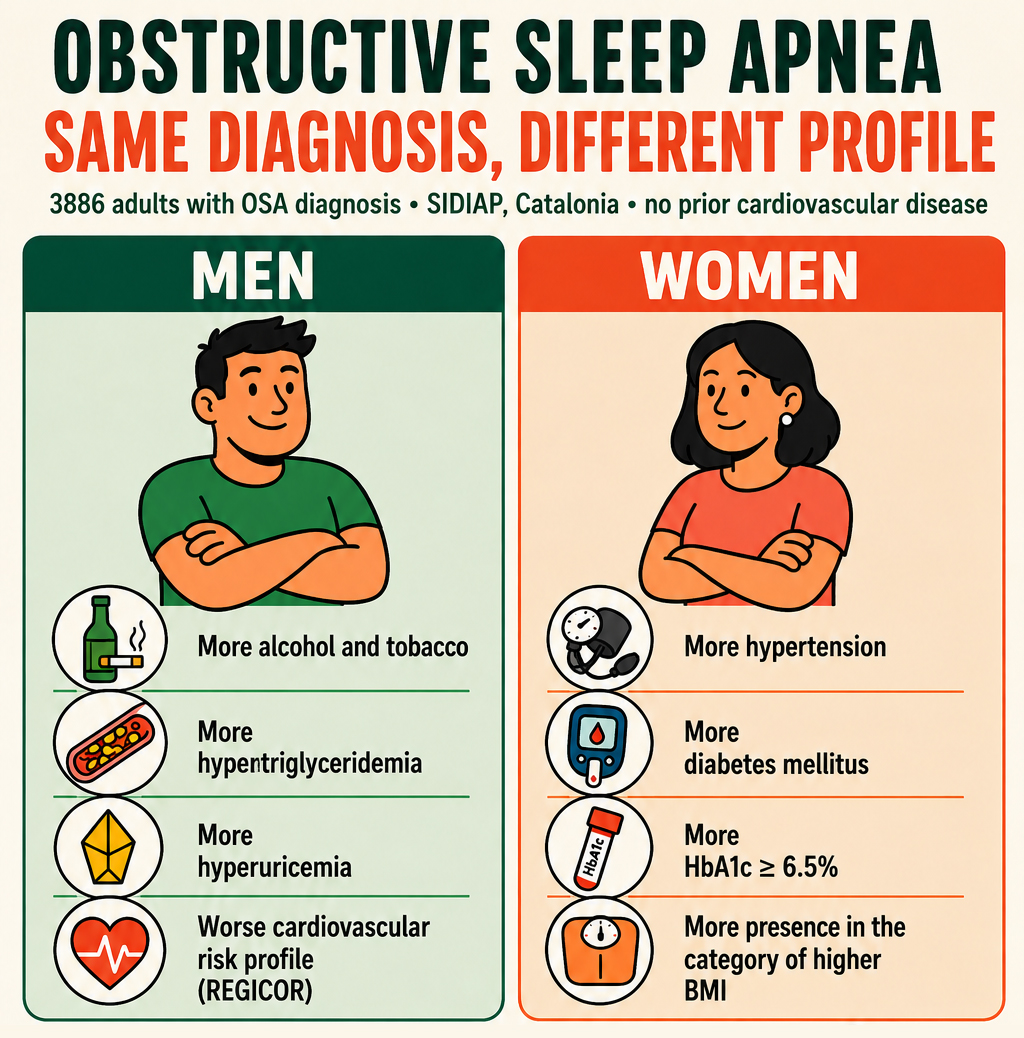
The profile of women and men with obstructive sleep apnea is different, which may lead to the underdiagnosis of the disease among women. This is highlighted by a study recently published in NPJ Primary Care Respiratory Medicine, a Nature journal, coordinated by a research team from the Northern Metropolitan Research Support Unit of IDIAPJGol.
The study identifies different patient profiles according to sex. Men with sleep apnea consume more alcohol and tobacco, have higher levels of “bad” cholesterol and poorer cardiovascular health indicators than women. In contrast, affected women have higher rates of obesity and overweight, as well as higher rates of hypertension and type 2 diabetes.
Regarding clinical presentation, the study findings are consistent with evidence reported in other countries, which shows differences between women and men in the way obstructive sleep apnea manifests itself.
According to previous studies, men more frequently experience symptoms considered typical, such as loud snoring, daytime sleepiness and episodes of choking during sleep accompanied by sudden awakenings. Women, on the other hand, may more frequently experience less specific symptoms, such as insomnia, fatigue, headache, mood disturbances or lack of energy.
Since the usual clinical criteria for diagnostic suspicion have been based primarily on the symptoms most commonly experienced by men, this difference in clinical presentation may contribute to the underdiagnosis of obstructive sleep apnea in women.
A combination of factors
The study highlights that the differences observed between men and women with sleep apnea are due to a combination of anatomical, hormonal, clinical and social factors. Anatomical differences in the upper respiratory tract may influence the degree of obstruction and disease progression, while hormonal factors may affect the prevalence and severity of the condition. Women also develop the disease at older ages than men and do so with a higher body mass index.
The research highlights that the majority of patients under the age of 40 are men, which is consistent with the fact that the disease is diagnosed earlier in men than in women due to differences in the way it manifests itself.
The article’s first author, Brenda Biaani León-Gómez, a researcher at IDIAPJGol, states that “these results indicate that sleep apnea is not a clinically homogeneous disease and that its specific characteristics need to be taken into account, particularly among women.” Biaani adds that “the study findings point to the need for a sex-sensitive approach to the diagnosis and treatment of sleep apnea that can improve the identification and management of the disease in women.”
The research was conducted by analysing the records of nearly 4,000 people diagnosed with sleep apnea who had no previous cardiovascular diagnosis. The participants were included in the Information System for Research in Primary Care (SIDIAP), the database containing data on people treated at almost all primary care centres in Catalonia.
A common disease
Obstructive sleep apnea is the most common sleep-related respiratory disorder. It is one of the major public health problems, with a considerable impact on the quality of life of affected individuals, and is associated with the risk of road traffic and occupational accidents. Around 20% of adults have this condition, which is diagnosed more frequently and at an earlier age in men than in women.
Article reference
León-Gómez BB, Mar Rodriguez Alvarez MD, Pujol Salud J, Thio EB, Erazo S, Antonio JR, Torán-Monserrat P. Gender differences in sleep apnea: a study of the catalan population. NPJ Prim Care Respir Med. 2026 Apr 14;36(1):40. doi: 10.1038/s41533-026-00512-7. PMID: 41980993; PMCID: PMC13270092.