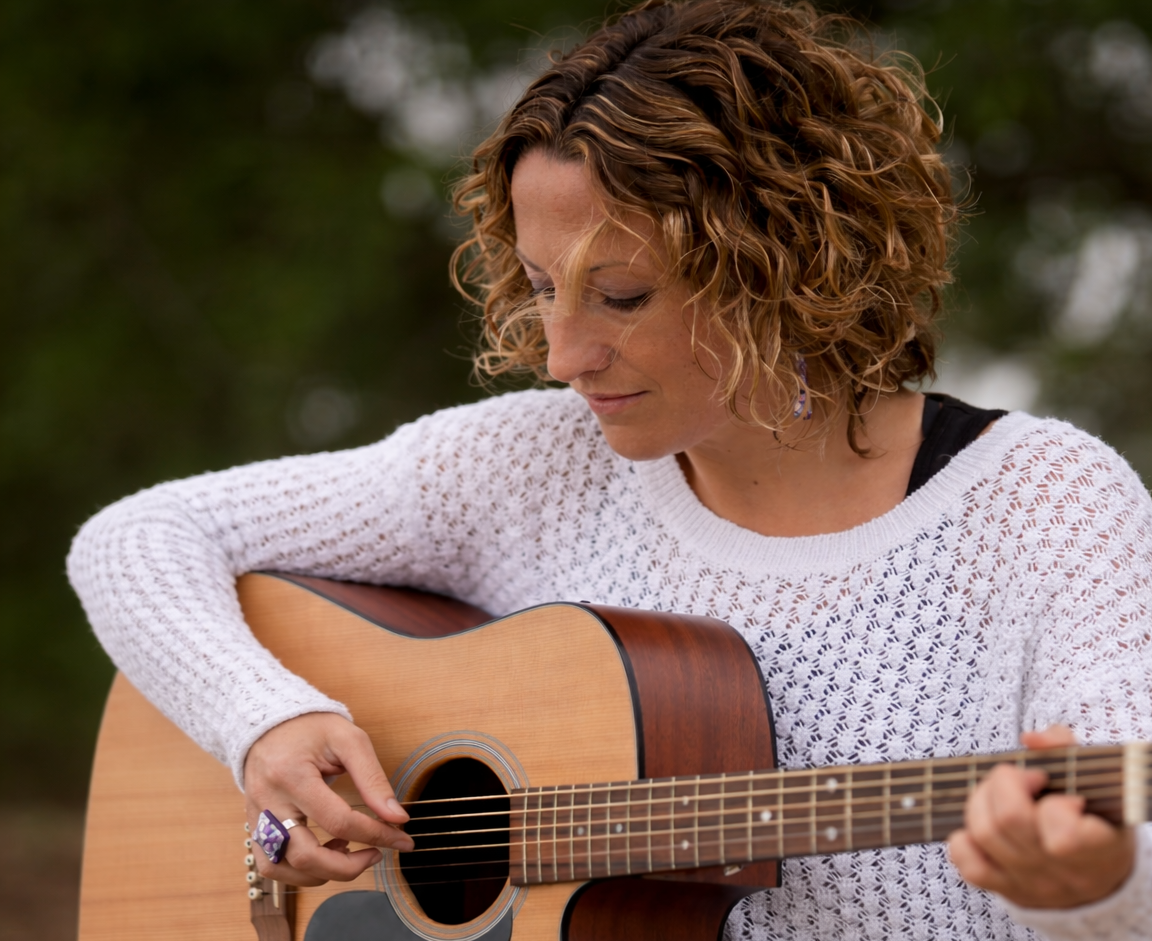
Midwife and singer-songwriter Nuria Risques, from CAP Lliçà de Vall of the Institut Català de la Salut, is leading an innovative study analyzing the impact of music—particularly singing—on mothers’ well-being during the postpartum period. The research, currently about halfway through and expected to continue for another year, compares the results of conventional postpartum workshops with those that incorporate music and singing.
Risques grew up in a very musical environment, and music has always played an important role in her life. “There are two things that have driven me since I was a child,” she explains, “music and the miracle of life.” After training as a midwife, she also decided to pursue music studies. This dual perspective naturally led her to introduce guitar and singing into the postpartum groups she worked with.
Evidence of the benefits of music
Over time, this practice evolved into a line of research. The publication in 2019 of a report by the World Health Organization (WHO) on the role of the arts in health and well-being provided scientific backing for something she had already sensed: that music brings both physical and emotional benefits to mothers and babies. The WHO report highlights that music reduces stress and anxiety during pregnancy, relieves pain during childbirth, lowers the risk of postpartum depression, strengthens the mother–baby bond, and increases breastfeeding rates.
Based on this evidence, Risques designed a study to assess how musical interventions influence women’s condition during the postpartum period, a particularly sensitive stage. “Postpartum is a very vulnerable situation,” says the midwife, noting that between 10% and 15% of mothers experience postpartum depression. Given this reality, she believes it is essential to explore strategies that can improve mothers’ emotional well-being.
An unbreakable bond
The researcher focuses on singing as the main tool. “Musical interventions include singing, playing an instrument, or making music in a group. Among all of them, singing is the most effective, and listening to music the least,” she says, adding that “in all civilizations, music and singing have been used as a form of communication between mothers and their babies.”
According to Risques, the value of singing has both an emotional and physiological basis: “The voice is the bridge between intrauterine and extrauterine life—an unbreakable bond.” In this way, the baby not only perceives sound but also vibrations and the hormonal effects associated with the mother’s well-being: “When the mother sings, the baby vibrates and perceives well-being through endorphins.”
Risques evaluates the effect of music on mothers’ emotional well-being by conducting postpartum sessions that incorporate singing into the usual activities of these workshops. To study their effectiveness, she compares the results with those from standard postpartum workshops.
For the study, she assesses both the experimental group (with music) and the control group (without music) using qualitative and quantitative indicators. Through questionnaires, she collects data on sociodemographic variables, mental health variables, aspects related to the quality of the mother–baby bond, and maternal self-efficacy. She also analyzes physiological markers such as oxytocin and cortisol levels in mothers’ saliva, before and after the interventions.
The eight sessions conducted in the experimental postpartum group follow a progressive structure in which infant massage is combined with different musical activities.
Each session has a specific theme. The first session is devoted to introductions and an introduction to infant massage. In the second, called “Rescuing the forgotten lullaby,” mothers recall lullabies they used to sing at home. In the third session, they learn new lullabies. In the fourth, they perform stimulation songs with gestures and puppets. “These puppets are very simple—we make them with recycled materials, because nature has provided us with everything we need for parenting,” explains Risques. In the fifth session, they do movement songs that teach parts of the body. In the sixth, mothers create a musical instrument—a maraca. The seventh session is dedicated to songs for routines. “One of babies’ abilities is to relate events to each other, which is why routines are so important; if we accompany these routines with a song, we help the baby recognize them,” she adds. On the eighth and final day, mothers share the songs they have composed for their babies.
Participation
One of the most notable elements of the program is its creative and participatory component. Throughout the sessions, participants—mothers and also some fathers—are encouraged to experiment and overcome their fear of singing. “It’s very interesting to see families’ imagination and creativity,” she notes. The ultimate goal is for each mother to create her own song for her baby, which is shared in the final session. In addition, each meeting begins with a personalized welcome song, helping to create an atmosphere of trust and cohesion. “When they start singing, it’s a magical moment,” she says.
Although the final results are not yet available, initial observations suggest that music—and specifically singing—has a positive effect on mothers’ well-being. Among the perceived benefits, Risques highlights the creation of bonds, both with the baby and among participants, the development of parenting resources, and overcoming the embarrassment of singing.
She also observes changes in the participants’ emotional and physiological state: “A peaceful atmosphere is created—the drop in cortisol and the increase in oxytocin generate a very calm environment.” The midwife from CAP Lliçà de Vall also emphasizes that mothers who take part in the workshops stay in touch after the sessions end.
Methodological guide
Nuria Risques explains that the ultimate goal of these workshops is to develop a guide describing the methodology she uses, so it can be applied by other midwives in activities for new mothers. “It would be fantastic if this methodology could be incorporated into all postpartum groups,” she says. However, she acknowledges that there is some reluctance toward singing, as it is a tradition many women have lost. In any case, she emphasizes the importance of providing evidence of the benefits of using music in postpartum workshops so that anyone who wishes can incorporate it—whether by singing, making music, or using recorded music.
In any case, Risques has composed and recorded songs so that anyone who wishes can use them to sing to their babies.