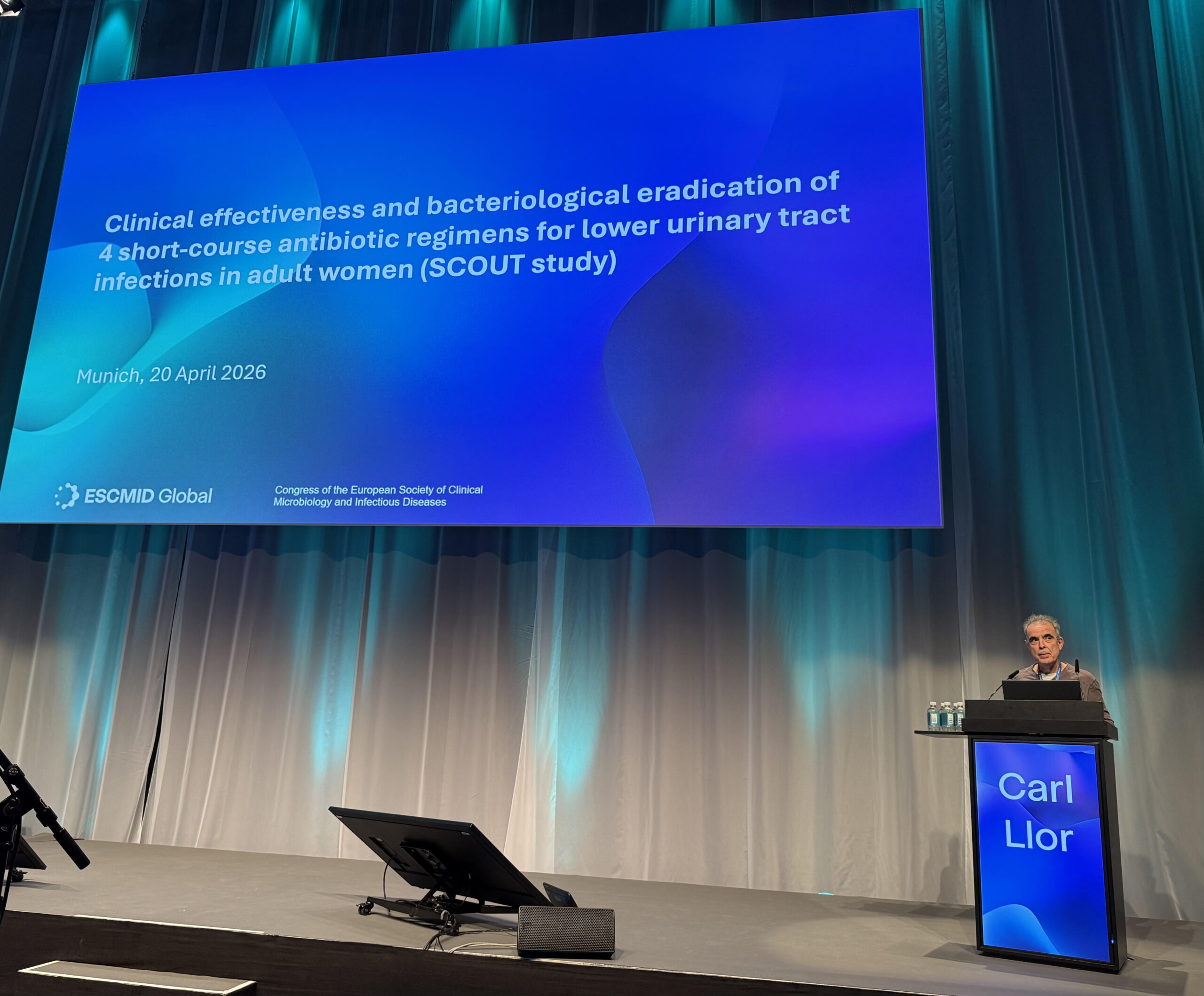
A study coordinated by the Primary Care Research Institute Jordi Gol (IDIAPJGol), published in The Lancet, concludes that single-dose fosfomycin trometamol for the treatment of uncomplicated urinary tract infections in adult women is less effective than other commonly used first-line antibiotic treatments.
The study compared, in a clinical drug trial, four antibiotic regimens indicated for the treatment of acute uncomplicated cystitis in adult women: nitrofurantoin (100 mg every 8 hours for five days), pivmecillinam (400 mg every 8 hours for 3 days), fosfomycin trometamol in two doses of 3 grams each, and fosfomycin trometamol in a single 3-gram dose.
Better results with nitrofurantoin
Nitrofurantoin achieved the highest cure rates on day seven, with 74.4% of women recovered. When focusing only on patients with infection confirmed by a positive urine culture, the rate reached 86.7%. Pivmecillinam and fosfomycin in two doses showed intermediate results, with cure rates of 69.8% and 67.4%, respectively. Finally, single-dose fosfomycin showed the lowest success rate (58.9%) and was the treatment most frequently requiring the prescription of an additional antibiotic.
Side effects across all treatments were mostly mild and related to antibiotic use, such as diarrhea or abdominal pain. No significant safety concerns were identified for any of the antibiotics.
The trial was conducted between April 2022 and December 2024 and included 768 women diagnosed with a urinary tract infection treated in primary care centers in Catalonia, Aragon, the Balearic Islands, and Madrid. Participants were randomly assigned one of the four antibiotic regimens under study. The aim of the study was to assess clinical cure on day seven of treatment, as well as safety and bacteriological eradication.
The study is part of the national SCOUT project, coordinated by IDIAPJGol researcher Carl Llor and the IDIAPJGol Drug Research Unit, and involved collaboration with research teams from the Aragon Health Research Institute (IISA), the Balearic Islands Health Research Institute (IdISBA), and the Foundation for Biomedical Research and Innovation in Primary Care (FIIBAP) in Madrid. It is the largest drug clinical trial ever promoted by IDIAPJGol.
Implications for clinical practice
The results, published in the latest issue of The Lancet, were presented this Monday at the European Society of Clinical Microbiology and Infectious Diseases congress, held in Munich.
Dr. Llor highlighted that the study results “reinforce the need to reconsider therapeutic recommendations for treating acute cystitis in women, which will help improve clinical outcomes and optimize antibiotic use.”
The five-day nitrofurantoin regimen has been recommended alongside single-dose fosfomycin trometamol as a first-line treatment in Catalonia and Spain. However, its use is infrequent and it is prescribed in a very low percentage of cases. The results of this clinical trial show that this regimen should be prescribed more often.
The authors question why the treatments showed differences in clinical cure, considering that resistance rates to the antibiotics studied in Escherichia coli—the most common uropathogen—are currently below 5% in Catalonia. The answer is that medical professionals often base antibiotic prescriptions on local resistance rates, but resistance alone does not fully determine clinical effectiveness.
The research team highlights that the study shows a discrepancy between in vitro sensitivity and clinical outcomes in real-world practice. This underscores the importance of considering additional factors when selecting antibiotic therapy.
Nitrofurantoin maintains sustained high urinary concentrations over several days, with a time-dependent mechanism of action. In contrast, fosfomycin reaches a very high peak, but its levels decline rapidly and may not maintain sufficient concentrations for long enough in all patients. Urinary tract infections may involve high bacterial loads, and a single dose of fosfomycin may reduce bacteria but not completely eradicate them.
Another point highlighted by the authors is that not all urinary tract infections are identical. Thus, “some patients may present early involvement of the upper urinary tract or intracellular bacterial reservoirs, and nitrofurantoin has better activity in bladder tissue over time. The reduced activity of fosfomycin in low pH urine, together with the persistence of E. coli in the bladder, could explain its lower effectiveness, as a single dose may not maintain a minimum inhibitory concentration in the urine long enough to eliminate the infection.”
Acute cystitis
Acute cystitis is the most common urinary tract infection in primary care. It is estimated that more than half of women will experience at least one episode of acute cystitis during their lifetime.
Several antibiotic regimens are used to treat this infection, although until now the evidence on which is most effective has been limited. The most commonly used antibiotic is fosfomycin, recommended in a single dose by clinical guidelines, although in recent years the two-dose regimen has been more frequently used in practice. Another recommended alternative is nitrofurantoin, although its use in clinical practice remains limited. In contrast, in other European countries, guidelines also include pivmecillinam as a treatment option for this condition.
This study provides evidence to reconsider the prescription of single-dose fosfomycin as the first-line antibiotic regimen.
Article reference:
Llor, C., Monfà, R., Garcia-Sangenís, A., Leiva, A., Marín-Cañada, J., Sánchez-Calavera, M. A., Moragas, A., Aguilar-Sánchez, M., Troncoso-Mariño, A., Rodríguez-Barrientos, R., Molero, J. M., Ouchi, D., Miranda-Jiménez, C., Fernández-García, S., & Morros, R. (2026). Clinical and bacteriological effectiveness of three different short-course antibiotic regimens and single-dose fosfomycin for uncomplicated lower urinary tract infections in women (SCOUT): a pragmatic, multicentre, open-label, randomised clinical trial. The Lancet. Online First April 20, 2026.