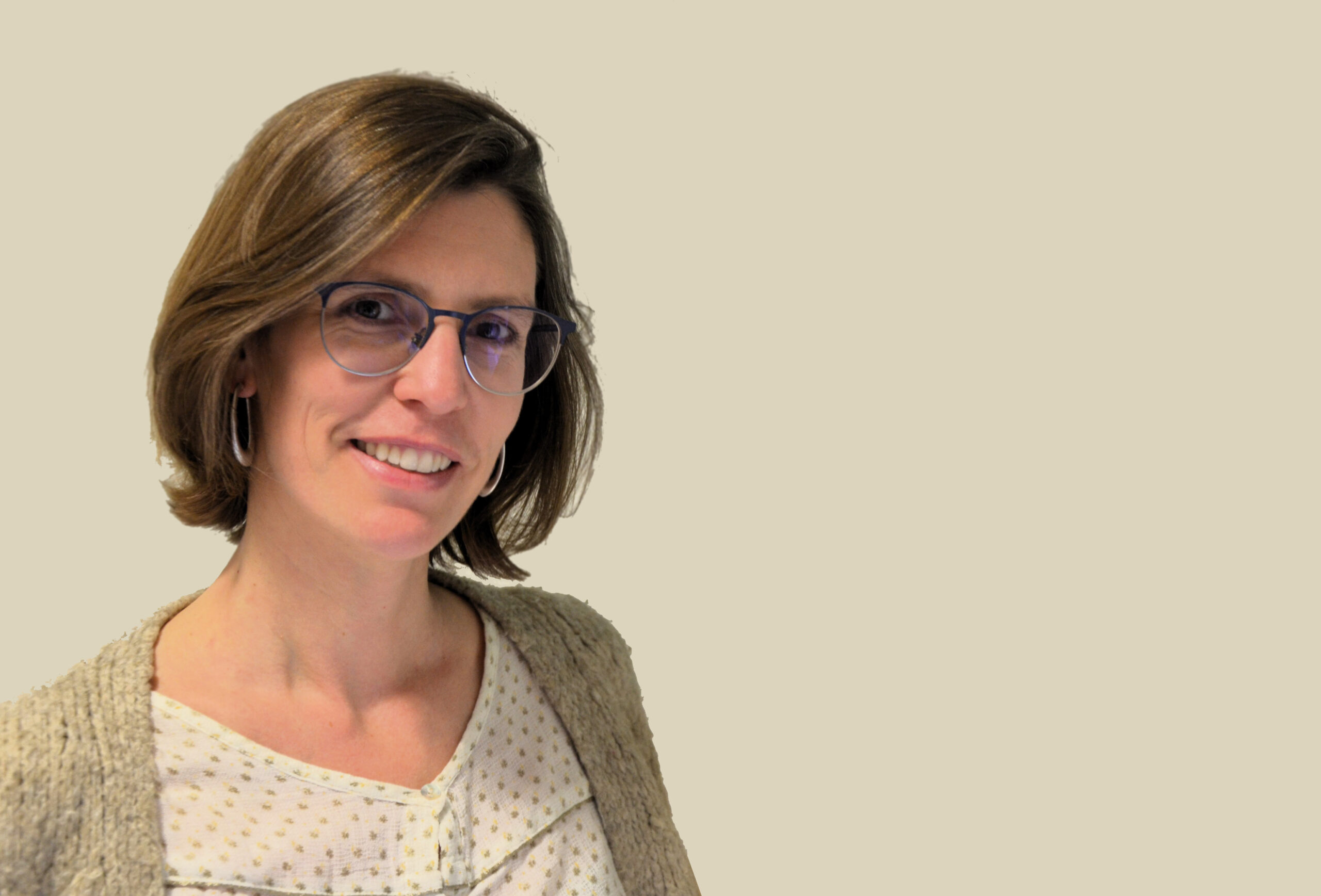
About ten years ago, Mariona Pujol joined IDIAPJGol as the coordinator of the Project Management Unit. From this department, she ensures that the Institute’s researchers can access funding sources that allow them to carry out their research. What attracts her to her work is the possibility of seeing the entire life cycle of research projects, from their conception to the achievement of results.
You have a degree in Pharmacy and a PhD in Biomedicine, and now you dedicate yourself to managing research projects. What led you to do this job?
After completing my PhD thesis, continuing as a researcher started to feel overwhelming. Basic research requires a great deal of dedication and a level of commitment I could not assume. Working conditions are very precarious and, moreover, I felt that I didn’t fit into that world, which was also very masculine. I realized that research was not for me. I joined the Bellvitge Biomedical Research Institute as a lab manager and later as a project manager in a research group, and I began to find project management work very appealing. I saw that research groups with this type of role obtain much more funding. In addition, it is a position that allows you to stay very close to research without the negative aspects of being a researcher.
Is the role of the project manager well defined?
No, our profession is very poorly defined. Those of us who work in this field have very different professional backgrounds. There is a European network of research management professionals, and it will likely become a university career in the future. What is clear is that having qualified management staff in research centers allows them to secure more resources.
What activities does the IDIAPJGol Research Management Unit carry out?
In the Unit, we support researchers so they can carry out their research. We do research promotion and research management. Promotion involves motivating primary care professionals who want to do research to apply for funding calls. Four of the five people working in the Unit have scientific training, which is very important because it allows us to advise researchers by speaking their language and understanding their needs. We bring added value to project management.
Furthermore, having a global view of the Institute, which is present throughout Catalonia, allows us to connect research lines and foster collaborations between people. We have a bird’s-eye view that allows us to connect research groups and lines of work.
As for management, we accompany researchers by taking care of the bureaucracy required to apply for public calls. We have the advantage of seeing the entire life of a project, from beginning to end.
How do you view IDIAPJGol?
I see IDIAPJGol as a committed institution with great potential. In our country, we have a primary care model that other countries do not have, and the existence of an institute like ours—focused on research in the first level of care—is very unique. In the rest of Spain, centers like ours can be counted on one hand, and in the rest of Europe, they are very rare; this makes us very attractive.
The problem is that professionals are overwhelmed and demotivated. Doing research in primary care is a voluntary activity. Professionals conduct research in their free time. This makes the cost of doing research very low, and for a research center this means little income through overheads; meanwhile, our projects have the same bureaucratic burden as basic research projects that handle much more money.
On the positive side, I would highlight the variety of our research. We address very diverse topics. In addition, our results have a very short trajectory: we quickly see the applicability of our research.
Funding is a critical aspect for maintaining research initiatives. What are the main funding sources for IDIAPJGol projects?
We apply for a great deal of funding from the Instituto de Salud Carlos III and the Department of Health, and we participate in European Commission funds. Most of our funding comes from calls issued by the Department of Health.
What changes have occurred in recent years in competitive calls, especially after the pandemic?
After the pandemic, research in mental health has been strongly promoted, as well as topics related to the health of healthcare professionals themselves. There are also more calls related to logistics and preparedness for potential future pandemics. Another challenge is the digitalization of the healthcare system, in which we are very behind in our country, as well as calls related to large databases—an area in which we, thanks to SIDIAP, are very well positioned.
Collaboration is often crucial in scientific research. What collaborations does IDIAPJGol maintain with other research institutions?
Some collaborations are more established than others, and many arise through personal relationships. With the research centers linked to the ICS, we share a common path, and we also obtain collaborations through the networks of the Instituto de Salud Carlos III. I would highlight our relationship with the Germans Trias i Pujol Institute, the Vall d’Hebron Research Institute, and the Pere Virgili Health Research Institute. From a management perspective, we also collaborate with IMIM, the Hospital del Mar Medical Research Institute, and, in terms of management structures, with the research centers of Hospital de Sant Pau and Sant Joan de Déu Hospital.