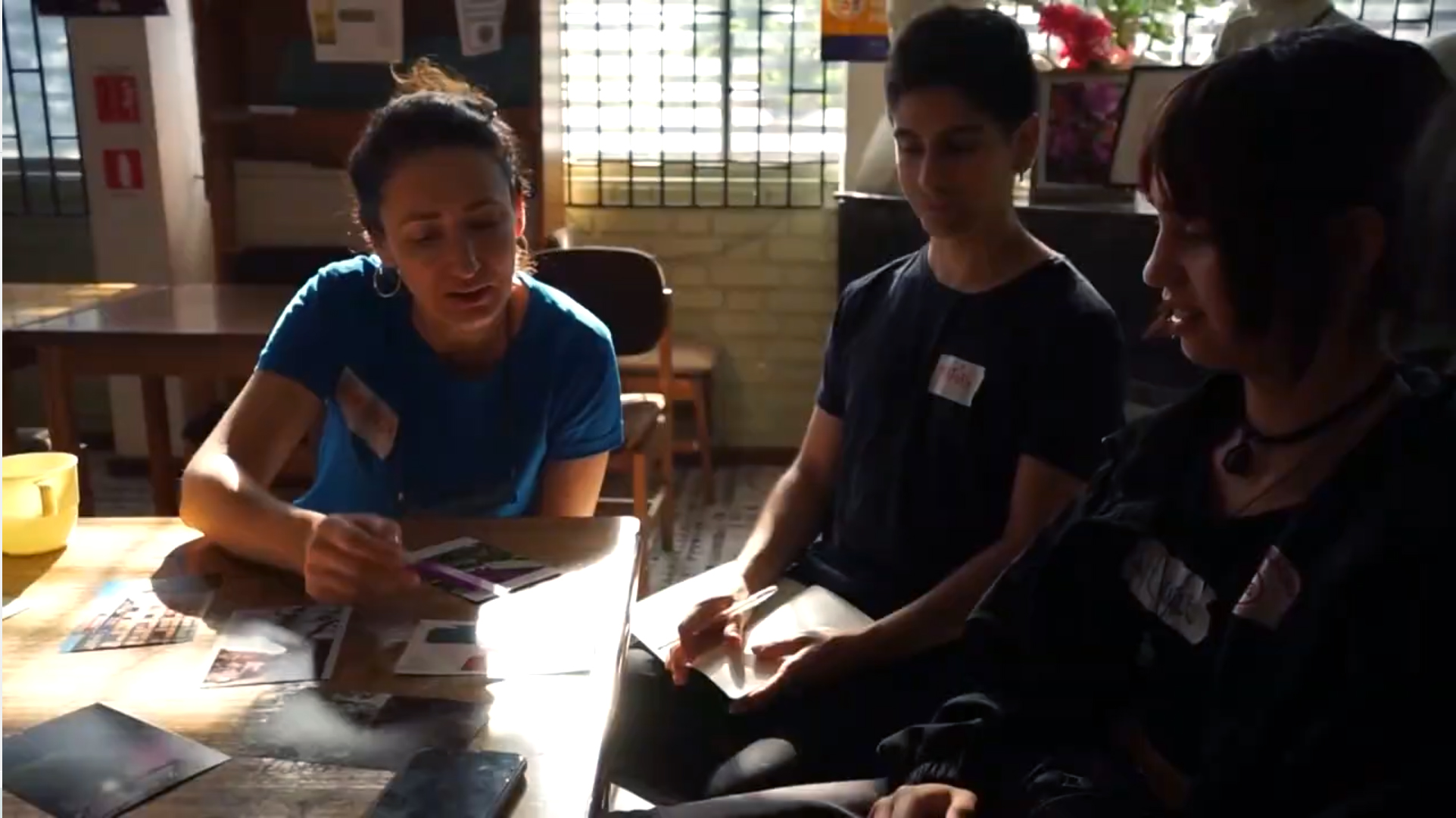
Dr. Constanza Jacques-Aviñó and two teenagers during one photovoice session
How young people feel emotionally is shaped by where they live, the people around them, and the social and material conditions in which they grow up. This is the conclusion of a study published in the journal Frontiers in Public Health, led by IDIAPJGol researcher Constanza Jaques-Aviñó. The study involved adolescents from an intercultural and economically disadvantaged neighbourhood in Santiago, Chile, who used the qualitative research method photovoice to express their experiences related to the things that make them feel well.
The study was carried out in 2022 and 2023 at a single-sex public school in an intercultural neighbourhood of Santiago, Chile, following two years of COVID-19 lockdown and virtual classes. Eleven adolescents aged 14 and 15 participated in the study (9 cisgender girls and 2 non-binary individuals). The process included workshops and discussion sessions in which 24 photographs were analysed, grouped into seven themes related to emotional well-being.
Photovoice method
The pandemic had a profound impact on the emotional well-being of many young people, particularly those living in contexts of economic, social and territorial inequalities.
This study identified the emotional impact of that period through the application of the photovoice method, which is inspired by participatory action research (PAR), a methodological approach that combines scientific research with social action. Photovoice uses photography to raise individual awareness and to create collective narratives that are often silenced or centred on adult perspectives.
This technique explores visual languages through which adolescents can express and represent emotions that are difficult to verbalise, recognising alternative ways of feeling and understanding.
Participants associated their emotional well-being with both intimate spaces, such as solitude or bonds with companion animals, and collective environments such as school, family, nature, activism and friendships. Unpleasant emotions, such as loneliness, were also interpreted as part of emotional development.
Spaces for participation
The study shows how adolescents’ emotional experiences are often influenced by factors such as gender, migration and social inequality, which shape how they live and perceive their lives.
Constanza Jaques-Aviñó explains that “the study highlights the importance of creating spaces for participation, active listening and mutual recognition among adolescents and between adolescents and adults.” The study’s lead author also calls for “the development of public policies that actively incorporate adolescent voices in order to improve their emotional well-being and to design policies and interventions that also affect them.”
Article reference
Araya-Tessini M, Anigstein Vidal MS, Arias-Schreiber Muñoz A, Jacques-Aviñó C. Photovoice, emotional health, and structural inequalities: adolescent voices from an intercultural neighborhood in the global south. Front Public Health. 2025;13:1709042. doi:10.3389/fpubh.2025.1709042