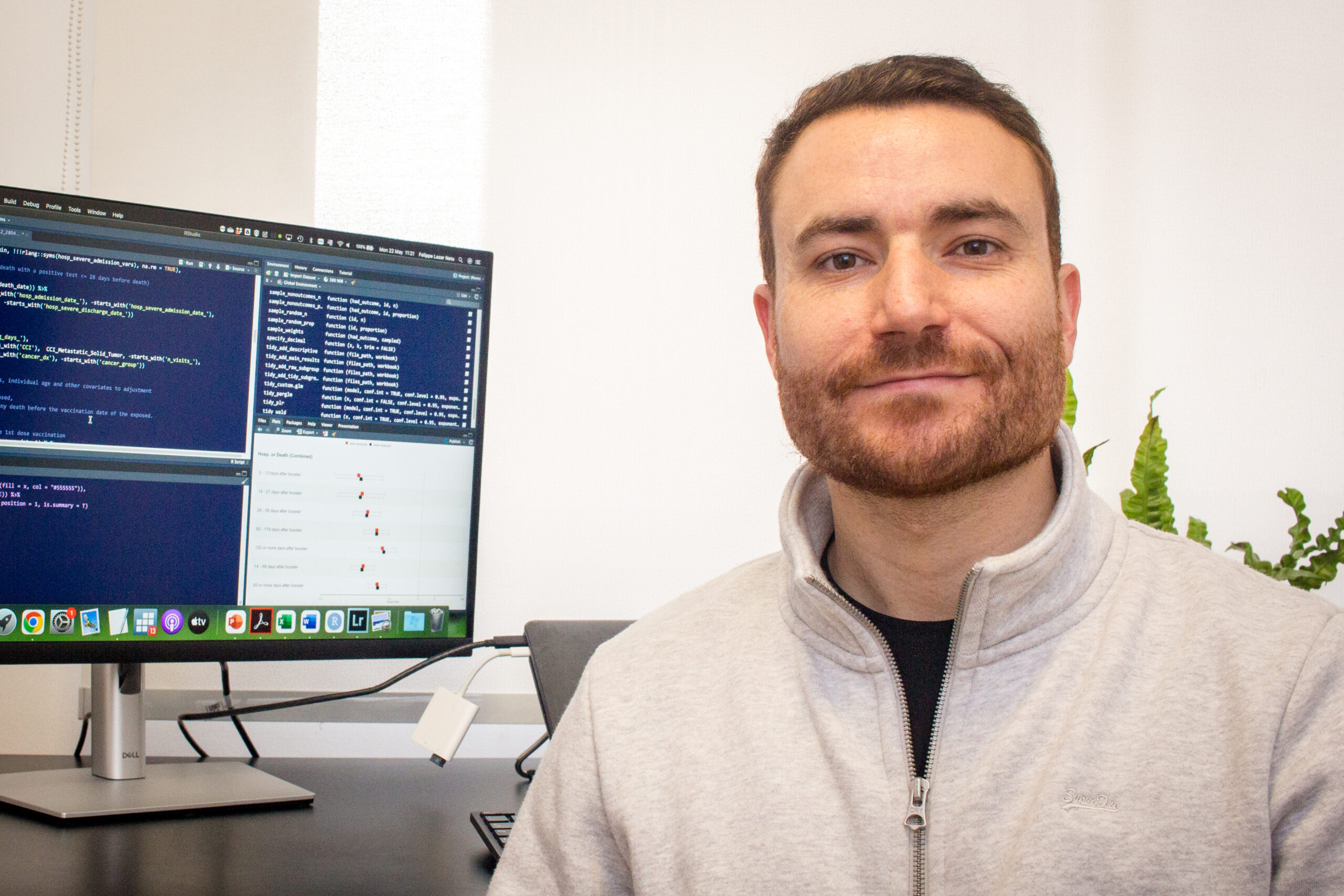
As part of its commitment to internationalization, IDIAPJGol participates in projects with cross-border impact. One example is the study on COVID-19 vaccination in oncology patients led by Felippe Lazar Neto, which compares vaccine effectiveness between Brazil and Spain. After conducting research at institutions such as the Harvard School of Public Health and the MD Anderson Cancer Center in Texas (USA), this Brazilian cancer specialist has recently completed a research stay at IDIAPJGol to work with SIDIAP data. We spoke with him to learn more about the study, his career, and what brought him to our institute.
How was your stay at IDIAPJGol?
The experience was wonderful. I was very impressed by the SIDIAP database. It is undoubtedly one of the most comprehensive data banks I have ever worked with. Everything was very well organized, making it easy to work with and extract data. Before arriving in Barcelona, I was worried that I wouldn’t have enough time to complete all the work in two weeks, but with the help of other researchers and thanks to the accessibility of the database, I managed to achieve most of the objectives. I felt very welcome; the atmosphere was great and everyone was very kind.
After Harvard and Houston, what has coming to Catalonia meant for you?
I spent a year and a half doing research in the United States during my medical training and had always considered returning there if I decided to go abroad again. However, this experience at IDIAPJGol has changed my perspective, and now I also consider coming here as a future option. I have discovered that high-quality research is also carried out in Europe and that there are many opportunities. Without a doubt, IDIAPJGol has opened the doors to Europe for me.
Why did you decide to specialize in oncology?
I have always been fascinated by the enigma of cancer—how a disease can be so impactful that it changes not only the patient’s life but also the lives of everyone around them. In addition, when I was young, a family member died of brain cancer. That experience marked me deeply, as they were under 30 years old when they passed away.
One of these projects is the one that brought you to our institute. What is the study about?
It is a PhD project on COVID-19 infection and vaccination in oncology patients. The mortality rate among these patients is very high. During the project design, my PhD supervisor, Octavio Tavares Ranzani from ISGlobal Barcelona, suggested conducting part of the research in collaboration with Talita Duarte Sallés’ group at IDIAPJGol, the Real World Epidemiology Research Group (RWEpi). I spent two weeks analyzing data from Catalonia using SIDIAP. The ultimate goal is to compare oncology patients from both countries and assess their clinical response.
What have you found in your analyses?
The analysis of vaccine effectiveness in Catalonia is particularly interesting because the types of vaccines used differed from those in Brazil. In Brazil, part of the population was vaccinated with inactivated virus technology (CoronaVac, from China). In contrast, in Catalonia most people received mRNA vaccines (Moderna or Pfizer) and adenovirus-based vaccines (AstraZeneca).
Will the results be published soon?
Our plan is to publish an article soon with the IDIAPJGol RWEpi group explaining the results of the analysis of SIDIAP data on vaccine effectiveness, both for the initial doses and for the booster (third dose). Later, the same will be done with the results obtained in Brazil. Depending on the findings in both countries, one idea is to publish a third article comparing the effectiveness of each vaccine to help inform future public health policies.