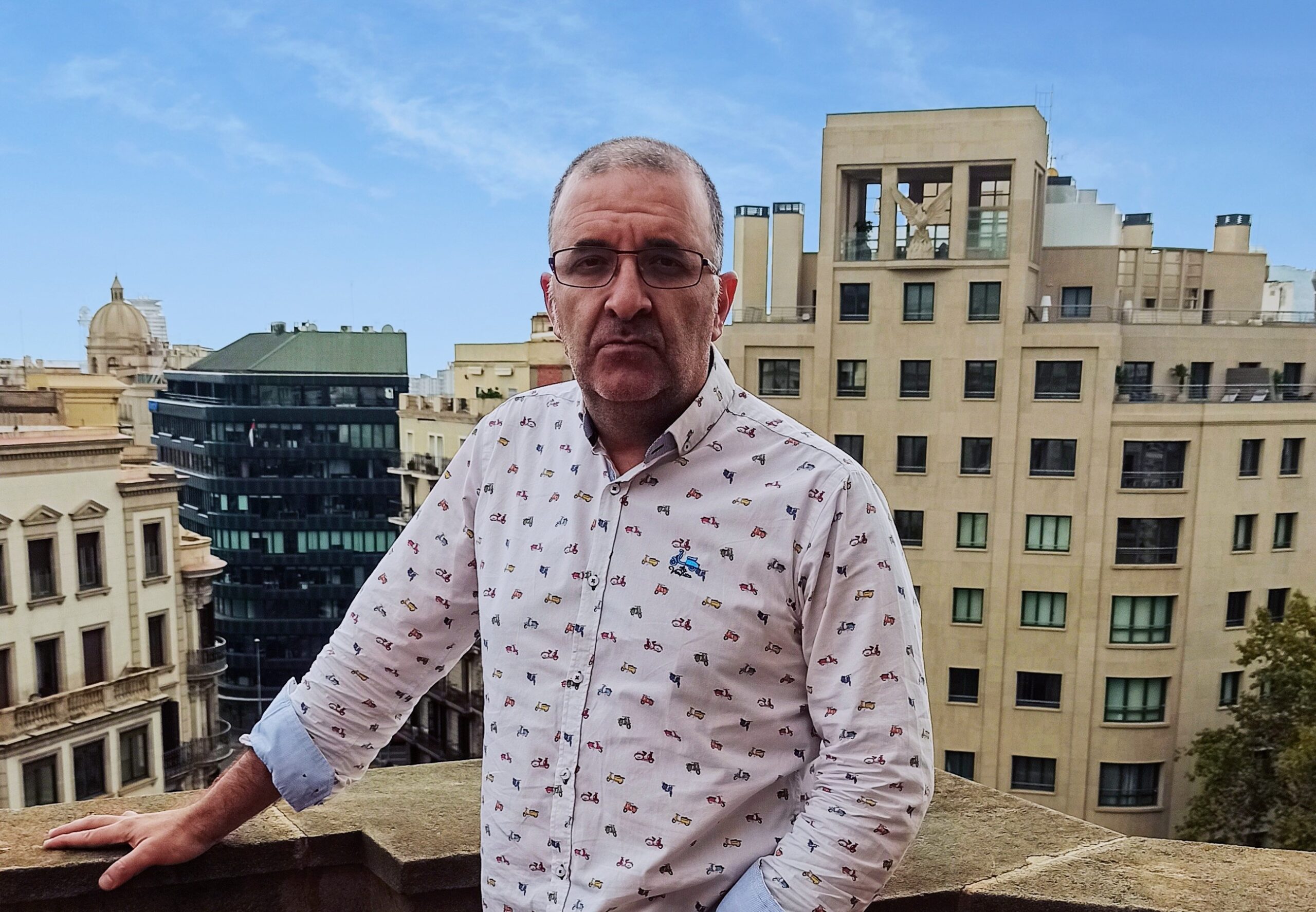
David Verde is a very atypical geologist. After graduating, he was Research Manager at the UB, Project Manager at the Fundació Clínic, R+D+I Promoter at the Fundació Bosch i Gimpera, and business development director at Ymaging. Five years ago he landed at IDIAPJGol and for the last two he has been the head of innovation.
You have a rather unusual career path for a geologist, don’t you?
I studied geology because it was a degree I liked very much. But well, other opportunities came up and the field of biology and biochemistry had always appealed to me as well. You get the “bug”, you enjoy managing projects, you learn how to prepare calls, help create startups, spinoffs, carry out license transfers or patent things and transfer them either to the market or to other companies. It is true that I worked as a geologist for one month and one day, as if it were an administrative or criminal sentence. And the truth is that I was a bit disappointed with how they did things and I quit.
In your last project before IDIAP, at Ymaging, you were part of a team of engineers, scientists and specialists creating innovative, company-specific solutions. What was that like?
We set up the company based on a grant we believed we could obtain from the Repsol Entrepreneurs Fund, and the idea was to work on things that were at the cutting edge of research, providing solutions to companies and ultimately to society, in problems that had never been solved before. At one point, the company grew a lot but things didn’t quite work out. Planning is very easy, but sometimes executing is not so much.
I understand you developed very interesting projects. Can you remind us of one?
We used artificial intelligence, around 2010, with images, to detect brain or heart diseases or to find oil or gas in a reservoir. We also used images to determine the weight of a pig, or we had to eat a huge amount of almonds to ensure that a well-known brand of nuts didn’t include any bitter ones in the bags sold. The problem was that the only way to check at that time whether the machine we had designed was right or not was by eating them, and the bitter ones had a cyanide compound that, apart from the unpleasant taste, if I had eaten 7 or 8, I might have ended up on the floor.
And four years ago you made a switch and joined IDIAPJGol. How did it all happen?
I knew the former director, Conxa Violant, and she told me there was a maternity cover position. And it is also true that Primary Care interested me a lot because it was something I had never worked in, and I have relatives who work in it, who are caring for people, and I was very excited to dedicate myself to it.
Even though you had already held a position in the medical field at the Fundació Clínic, how did you experience the change?
When I was at the UB Science Park, I learned many things about drug development from the point of view of diabetes in the first group, obesity and other types of rare diseases. And when I was at the Clínic, I was in a group that was very, very, very advanced at that time; we worked on maternal-fetal medicine, and in fact the person who led us was one of the three people in the world performing fetal surgery at that time. Here at IDIAPJGol, the best thing is that we study many diseases and we are not focused on just one, and that’s why I learn new things every day.
You started as an international project manager, but for two years you have been the head of the Innovation Unit. What do you think you are contributing to IDIAPJGol?
What we are contributing, not just me but the whole team, is the idea of a service vocation, of trying to help other researchers; at first it was difficult for them to understand where the line was, so to speak, between research and innovation. I think this line is becoming better and better defined. We try to make them feel comfortable, not afraid, because they have a sort of safety net which is us and which, at some point, they will no longer need. We have instilled this seed in a certain number of people so that everything they are doing —which they usually do outside their clinical working hours— does not remain a paper written and stored in a drawer, but is implemented. This is our obsession. And we also have a mantra: when you implement something in Primary Care, you implement it for the whole population: for us, for my mother, my sister, my neighbour… Everyone can benefit from this improvement.
Speaking of innovations, which ones are you working on?
Some of the most advanced projects we have range from apps to quit smoking to designing a mobile phone holder to detect and diagnose a specific type of vertigo that affects many people, which is usually not treated in the best way and becomes recurrent in many patients. Pau Gasol, for example, has suffered from it and spent months without playing, and also Maialen Chourraut, a white-water canoeist, or the swimmer Mireia Belmonte, who was almost six months unable to swim because she had this vertigo. Besides this, we are also working with a person who developed a game to try to minimise the effects of Alzheimer’s or dementia as a result of a personal problem suffered by his father. We are shaping the project so that all clinics and care homes can have this game.
This week the new Salut/AI Programme has been presented, a strategic initiative to ensure the ethics, equity, efficiency and coordinated sustainability of artificial intelligence solutions in health in Catalonia. I imagine you at IDIAPJGol have been using it for a long time, right?
There are indeed projects related to this topic because we are an attractive partner due to managing the SIDIAP, although legally it has limitations that do not allow it to be used in the way many private entities would like. Now we are beginning to run small-scale internal tests and we are beginning to form good alliances with centres that have strong artificial intelligence teams. In fact, we will submit a European project related to a non-communicable disease, with which we believe we could advance the diagnosis by between 6 and 12 months.
As you told us, applying AI to SIDIAP could yield impressive results…
Precisely, another thing we want to do is work with synthetic databases, because many of the limitations we have when using real patient databases would be avoided. The great advantage is that we have SIDIAP to be able to create them; we have the technology, but the real quality of these data still has to be verified.