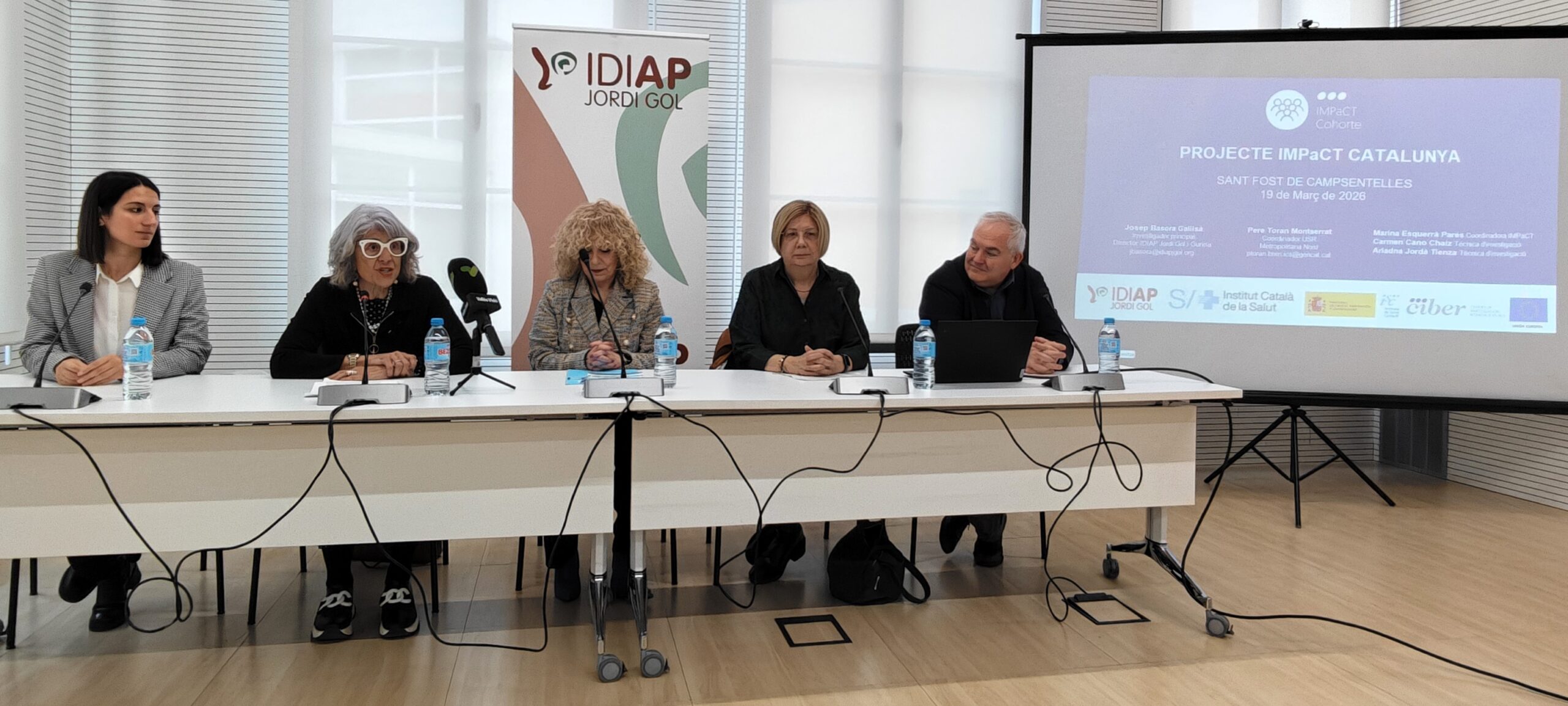
A total of 4,000 people aged between 16 and 79 from Sant Fost de Campsentelles, Martorelles and Santa Maria de Martorelles will take part over the next twenty years in the Cohort IMPaCT macro-study, a nationwide project aimed at better understanding the origins of the main diseases and thereby helping to prevent and treat them through the application of personalized and precision medicine techniques.
The project is promoted by the Carlos III Health Institute, under the Ministry of Science, Innovation and Universities. In Catalonia, it is coordinated by the Jordi Gol Primary Care Research Institute (IDIAPJGol), in collaboration with CatSalut and the Catalan Health Institute (ICS). Across Spain, a representative sample of 200,000 people will be studied, 28,000 of whom are from Catalonia.
In Vallès Oriental, the study will cover the population served by the Martorelles–Sant Fost de Campsentelles Primary Care Team, which provides care to around 15,000 people.
This is one of the seven areas in Catalonia where the study is being conducted, alongside Baix Francolí (Camp de Tarragona), the Ebre Delta, L’Hospitalet de Llobregat, Manresa, Lleida and Girona.
The study sample includes people aged 16 to 79 who are contacted by their primary care centre (CAP), where the research is coordinated, and invited to participate.
Participants will be followed by collecting information on their lifestyle habits and health status through questionnaires, physical examinations, physiological tests, and biomarker analysis, all carried out at the CAP.
If you get a call, come!
To ensure the project’s success, it is essential that those invited to participate agree to collaborate.
In this regard, Josep Basora, director of IDIAPJGol and principal investigator of the study in Catalonia, highlights that “citizen collaboration in this project is essential, and it is therefore key that people understand its potential, which will lead to improved health for the entire population.”
Montserrat Sanmartí, mayor of Sant Fost de Campsentelles, notes that “our municipality’s participation in this study represents a unique opportunity to deepen knowledge about our citizens’ health and to add value to the overall project, with the aim of contributing to improved health at a general level.”
Meanwhile, Candela Calle, manager of the Barcelona Metropolitan North Health Region, emphasizes that “this project is an example of how research results will enable citizens to influence their own health and that of future generations.” Addressing the public, she adds: “If you receive a call from your CAP to participate in the study, say yes: you will receive very comprehensive information about your health status and, in addition, you will help build a healthier future for the whole population.”
Yolanda García, director of the Martorelles–Sant Fost de Campsentelles Primary Care Team of the Catalan Health Institute, adds that “this is not just a research study; it is a shared responsibility,” noting that “the study allows us to go beyond daily primary care practice and become direct agents of change in the healthcare paradigm.”
Towards precision medicine
The project is promoted by the Carlos III Health Institute (ISCIII) through the Biomedical Research Networking Centre (CIBER) and aims to create a large population cohort of 200,000 people across Spain.
“We want to understand the role played by lifestyle habits, genetic susceptibility, and the specific characteristics of the Spanish population and our environment in the origin of the main health problems and in disease prediction,” explains Marina Esquerrà, researcher at IDIAPJGol and coordinator of the study in Catalonia.
To prevent the onset of disease, it is essential to understand the factors that cause it. Having information on many people and following them over time will make it possible in the future to predict everyone’s risk of developing disease. Advances in genomics and information and communication technologies facilitate this personalized approach.
Population macro-studies such as Cohort IMPaCT have already been carried out in countries such as the United Kingdom, France, Germany, Sweden and the United States. These cohorts collect biological samples and epidemiological information, including social and economic factors, and constitute a fundamental tool for advancing personalized prevention. In this sense, Cohort IMPaCT will enable Spain to make a qualitative leap forward in precision medicine research.
High-value data for the scientific community
The data collected from participants will be available to develop other scientific projects of interest to society. “Cohort IMPaCT will allow the scientific community to better understand how to prevent major diseases and age-related decline, injuries and disability,” explains Beatriz Pérez, principal investigator of Cohort IMPaCT in Spain and coordinator of the Department of Epidemiology of Chronic Diseases at the National Centre for Epidemiology of ISCIII.
The possibility of having a dynamic registry of individual and population data—clinical, genetic, epidemiological and lifestyle-related—will enable the development of predictive models of disease, the identification of health inequalities, the monitoring of key indicators, and the evaluation of the impact of health policies.
Cohort studies
Cohorts are studies in which a large group of people representative of the population is selected, and detailed data are collected from each participant over the years. The creation of the Cohort IMPaCT is a joint effort involving health services across Spain and the National Statistics Institute. A total of 21 institutions are collaborating, including primary care centers, hospitals and research centres. Scientific coordination is carried out by CIBER, with the advice and participation of numerous researchers and healthcare professionals from across the country.
The study will be conducted in a total of fifty health areas (IMPaCT centers) across Spain, seven of them in Catalonia, from which participants will be contacted and monitored. The project began in March 2023 with a pilot test in Mallorca and Madrid and has since been progressively rolled out to other centers in different autonomous communities.