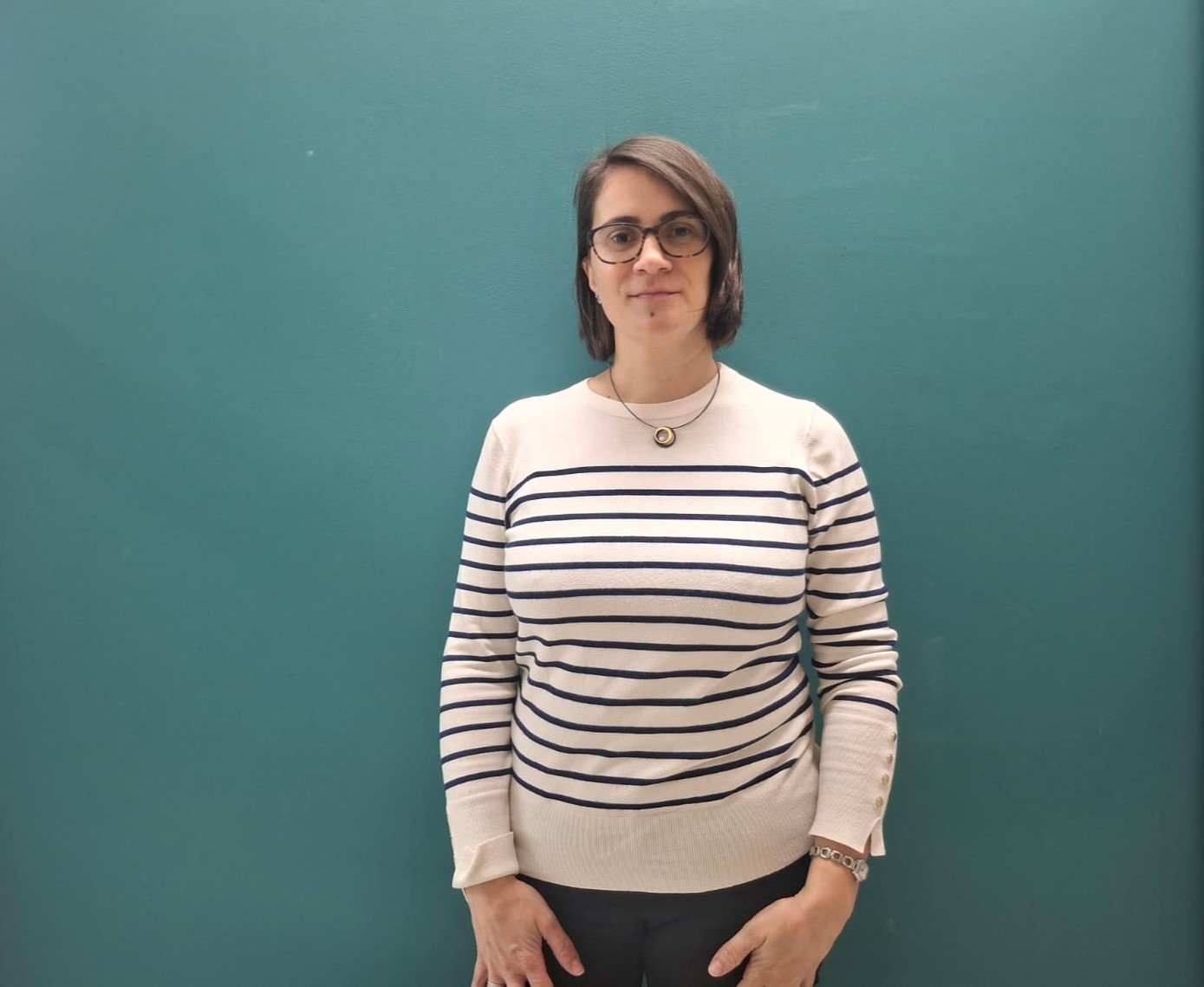
Just under a year ago, IDIAPJGol established its Works Council for the first time, an important step in ensuring the participation of the institution’s professionals in decision-making. For the past few months, Mari Fernández has taken on its presidency, in a period marked by collective learning, a willingness to engage in dialogue, and the need to respond to an institution that has grown significantly in recent years.
Fernández is part of the Institute’s Corporate Resources area, where she works in the financial management of research projects. From this perspective, and without coming from a research background, she strongly defends primary care research and the key role of the people who make it possible. In this interview, she discusses the priorities of the centre’s staff, job stability, career development, the work environment, and the pending challenges as a public foundation.
The IDIAPJGol Works Council is relatively recent. How was it created and with what objective?
The Works Council was created less than a year ago, following the elections in May 2025. Until then, IDIAPJGol had never had one, and its creation responds to several needs. On the one hand, it is a mandatory body given the current number of employees at the institution and, on the other, there were moments of dissatisfaction that made clear the need for a formal space of representation.
The main objective of the Council is to act as a communication channel, as a bridge between employees and management, in both directions. To gather concerns, requests and proposals, but also to help explain certain decisions or organisational limitations.
Has taking on the presidency of the Council been a personal challenge?
Absolutely. None of the people who are part of the Council had previously served in a similar body, which means we are all learning together. It is also a new experience for the institution itself. That said, from the very beginning there has been a clear intention to do things properly and to create a working dynamic based on cordiality and dialogue.
Being president does not mean making more decisions than anyone else. I believe the Council operates in a very horizontal way, and decisions are made collectively. In my case, I took on the role because I was already part of the initial candidacy and because I am motivated to get involved and understand what is happening within the organisation to help improve it.
Currently, the Council is made up of: Marc Casajuana Closas, who serves as secretary; Oriol Cunillera Puértolas and Thelma Román Simon, as representatives of the Occupational Risk Prevention Committee; Maria Giner Soriano, Equality Delegate; Macarena Pozo Ariza, representative for Tarragona; and me.
What would you say are the main priorities and concerns of IDIAPJGol professionals?
Without a doubt, job stability and career development. IDIAPJGol is a primary care research institute, a very specific field within health research, and many people begin working linked to projects with limited duration. This situation creates uncertainty about their future: what will happen when the project ends, whether there will be continuity or whether they will need to look for opportunities elsewhere.
Another key aspect is the professional pathway within the institution. Knowing what options are available, how one can grow, what kind of career progression is possible. In this regard, the recent approval of a professional career framework within the Institute is an important step forward, although there is still room for improvement.
What do you think people value most about working at IDIAPJGol?
First and foremost, the type of work. Conducting research in primary care is a vocation. I am not a researcher, but I always say that our researchers are almost heroes. They carry out research in a field that is not always sufficiently visible yet has a direct and highly relevant impact on people’s health.
At the same time, everyone working at IDIAP also greatly values the positive work environment, flexibility, remote working and work-life balance measures. Being able to organise oneself, having time for personal and family life, and feeling treated as a person and not just as a resource, is very important. This is clearly reflected in the annual workplace climate surveys.
Beyond all the positive aspects, how are working conditions in this field perceived?
As a public foundation, IDIAPJGol has many strengths, but also limitations. Salaries are often the main concern, as it is difficult to compete with industry or other institutions with larger budgets. This affects competitiveness and the ability to retain talent.
Even so, I believe there is a willingness to improve. It is a complex balance between what one would like to do and what can actually be done, taking into account budgetary frameworks and decisions that depend on higher governing bodies such as the Board of Trustees.
IDIAPJGol has grown significantly in recent years. How is this growth experienced internally?
When I joined the institution about ten years ago, we were around fifty people. Now we far exceed one hundred. This growth is very positive, but it also brings new challenges: space, organisation, internal structures, new committees… All of this has had to adapt to the new dimension of IDIAPJGol.
Regarding physical spaces, I believe that the location of teams greatly affects professionals’ sense of belonging. Integrating teams and preventing anyone from feeling disconnected is essential to building a strong collective project and maintaining a positive work environment.
How would you assess the current relationship between management and employees?
I believe there is a good willingness on everyone’s part. At the beginning there was some uncertainty, as everything was new, but over time a dynamic of trust and communication has developed. Naturally, there are disagreements and negotiations, as in any organisation, but the willingness to reach agreements is there.
The Council exists precisely for this reason: to manage differences, listen to all parties and find common ground. I believe that if there are willingness and respect, progress is always possible.
Would you say that one of the challenges is encouraging greater involvement in the committees?
Yes, it is true that it is not easy. Initially there is interest, but day-to-day workload and the fact of having to step forward publicly mean that many people take a step back. Even so, it is important to continue encouraging participation, so that representation is truly diverse and territorially balanced.
I would like to encourage people to get involved in the different committees within IDIAP. It is true that involvement requires time and effort, but it is essential to building a more participatory and cohesive institution.
Looking ahead, what would you like the Works Council to contribute to IDIAPJGol?
I would like it to be a useful, dynamic and approachable space that helps improve communication and people’s well-being. I hope the Council is perceived as a resource, not as a problem, and that it contributes to making IDIAPJGol a place where people want to stay, grow and get involved.