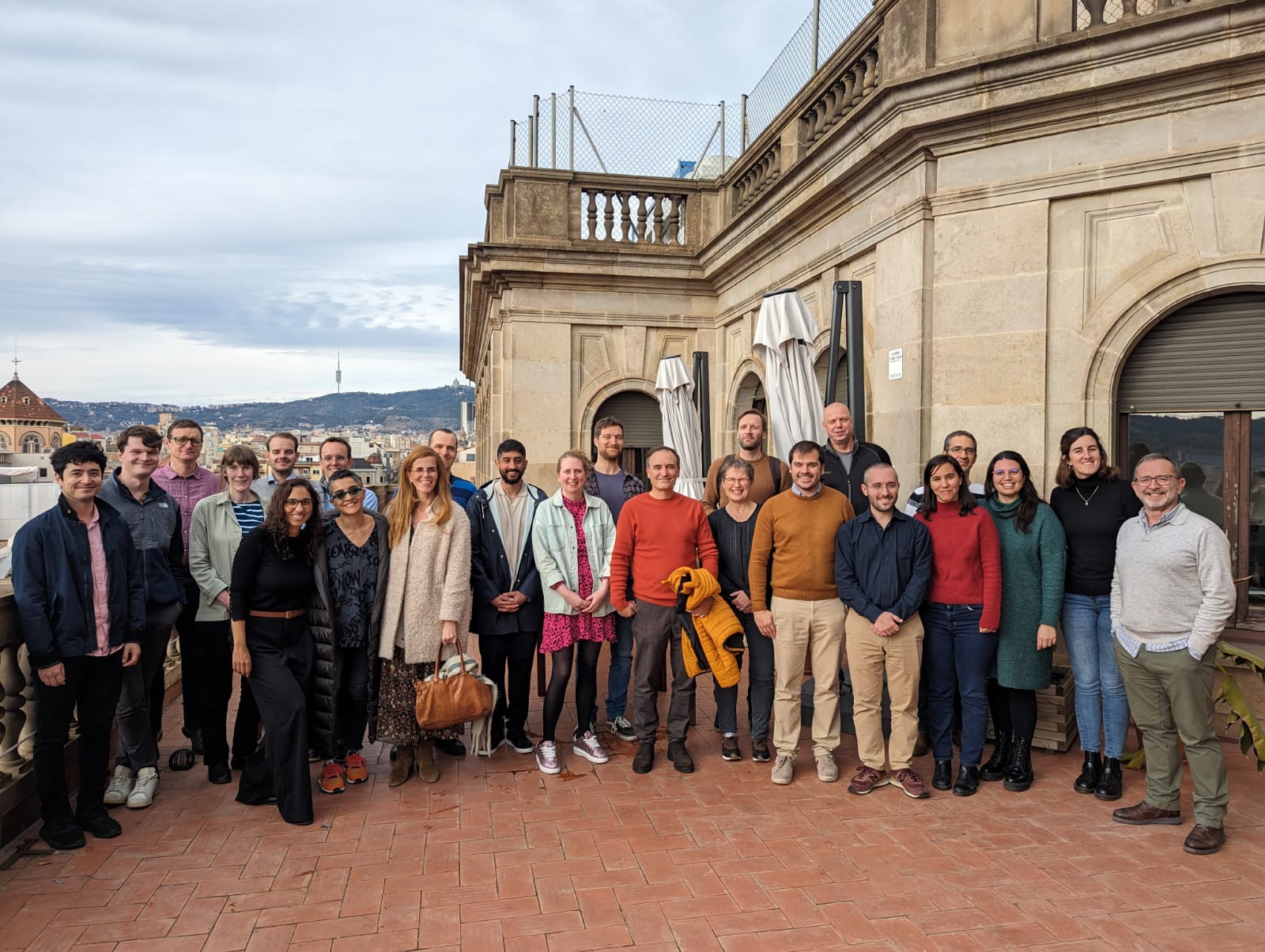
Study's research team during a meeting held in IDIAPJGol headquarters on January 2024
An international study coordinated by the Institut d’Investigació en Atenció Primària Jordi Gol (IDIAPJGol) analyses comorbidities, medication use and overall survival in more than 1.7 million people diagnosed with eight types of cancer in Europe. The work, led by IDIAPJGol researcher Talita Duarte Salles, has been published in The Lancet Regional Health – Europe and provides a new perspective on the real-life disease trajectories of people with cancer, using real-world evidence derived from routinely collected healthcare data.
The research team analysed eight types of neoplasms with a significant impact due to their frequency or mortality: breast, prostate, colorectal, lung, pancreatic, stomach, liver, and head and neck cancers, in individuals diagnosed between 2000 and 2019.
Data from eight countries
The study includes data from eleven clinical databases and cancer registries from eight European countries (the Netherlands, the United Kingdom, Norway, Finland, Switzerland, Portugal, Estonia and Spain), harmonised using the OMOP Common Data Model (OMOP-CDM). This approach enables standardised and federated analyses of clinical information without sharing individual-level data, thereby preserving patient privacy.
In Spain, records of patients with the eight selected cancer types were drawn from the Information System for Research in Primary Care (SIDIAP) of IDIAPJGol, the hospital database of Hospital del Mar – Institut Municipal d’Assistència Sanitària (IMASIS), and the information system of Hospital Universitario Virgen Macarena in Seville (HUVM). The number of patients recorded was 213,590 in SIDIAP, 13,315 in IMASIS and 12,275 in HUVM. The database contributing the largest number of patients to the study was the Netherlands Cancer Registry (NCR), with 943,196 patients.
Differences in survival
The results show substantial differences in survival depending on tumour type. Breast and prostate cancers present the highest survival rates, with five-year survival ranging approximately between 75% and 85%. In contrast, pancreatic cancer continues to have the poorest prognosis, with five-year survival in some countries not reaching 5%.
The study also highlights significant variations in survival between countries and between different types of data sources (primary care, hospitals or cancer registries), reflecting differences in healthcare system organisation, early detection practices and the quality of available data.
Comorbidity
One of the most innovative aspects of the study is the analysis of pre-existing conditions and medication use prior to cancer diagnosis—information that is often not available in traditional oncology registries.
The results reveal patterns consistent with known risk factors and potential early symptoms. Anaemia is frequently observed before the diagnosis of gastrointestinal cancers; chronic obstructive pulmonary disease and pneumonia are common among people with lung cancer; and diabetes and chronic liver disease are prevalent in pancreatic and liver cancers.
The participation of primary care databases such as SIDIAP was key to identifying these comorbidities and prior treatments. This information is essential to better understand diagnostic pathways, identify potential early warning signs and design more effective prevention and early diagnosis strategies.
IDIAPJGol researcher Irene López Sánchez, first author of the article, notes that “this research shows how the use of multiple real-world data sources can help us better understand the burden of cancer in Europe, providing a comprehensive, scalable and easily updatable view of disease progression from diagnosis to outcome.”
Talita Duarte Salles, for her part, emphasises that the study “highlights the value of primary care in the early detection of cancer.” The study coordinator underscores the importance of the first level of care in the prevention and early detection of oncological diseases.
Multicentre study
The study involved researchers from around the world. In Spain, research teams from the Hospital del Mar Research Institute, the Institut d’Investigació Biomèdica de Girona, the Institut Català d’Oncologia, Hospital Universitario Virgen Macarena in Seville, and the Instituto de Biomedicina de Sevilla participated, in addition to IDIAPJGol.
Article reference
López-Sánchez I, Palomar-Cros A, Claire R, Pérez-Crespo L, Giuliodori A, Koblbauer I, et al. Comorbidities, medication use, and overall survival in eight cancers: a multinational cohort study of 1.7 million patients across Europe. Lancet Reg Health Eur. 2026 Apr;63:101585. doi:10.1016/j.lanepe.2025.101585.