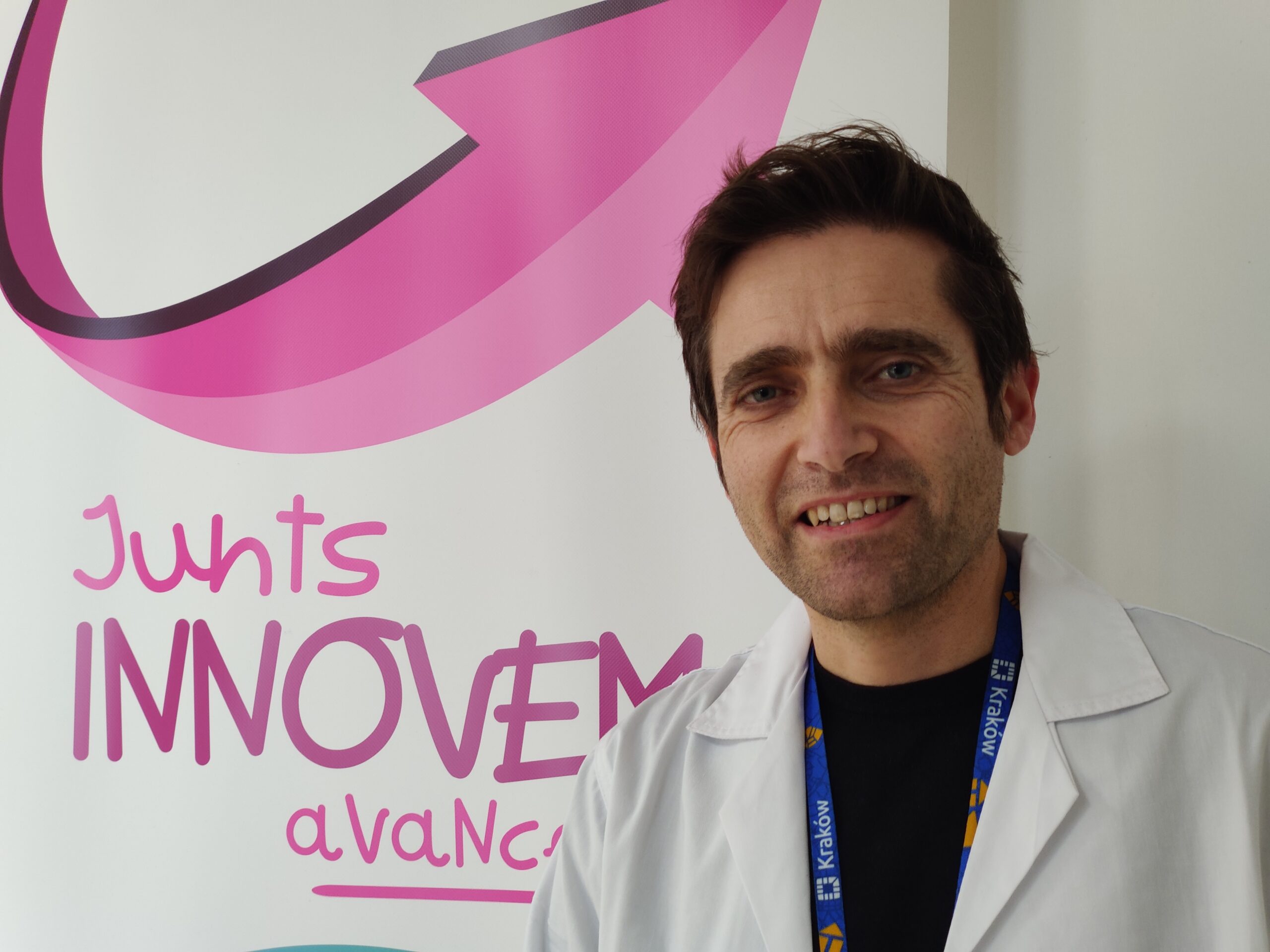
The work carried out at IDIAP Jordi Gol in healthcare research grows year after year. One of the keys to this success lies in the projects managed through the different territorial Research Support Units. Each of them is led by healthcare professionals with a strong vocational commitment to research. Without a doubt, one of them is Josep Vidal Alaball, coordinator of the Central Catalonia RSU. We speak with him about the value of being a rural doctor, the projects developed by this unit, and the first edition of the Centra’t Grants, which will be awarded in Manresa on June 6.
What led you to become a family doctor in Navàs? Did you always know you wanted to stay close to home (Berga and the surrounding area)?
I spent eight years living in the United Kingdom, away from home and far from my family. I was always sure that one day I would return and that when I did, it would be to live in Berga. For me, there was no point in coming back unless it was to be close to home and for my children to grow up near the family.
When I returned, I started working as a doctor in Bagà and Vallcebre, and after a period in management, I worked in Artés, Navarcles, Balsareny, and now in Navàs. I like being a doctor in small towns, and that’s why whenever I’ve had the option, I’ve chosen to work in a rural setting.
What does rural medicine offer that medicine in large cities does not?
I believe it offers greater proximity to the population; it is easier to truly get to know patients and their social environment. This gives you a lot of information and often explains their health problems. In addition, I think that as a doctor you have a better professional quality of life and probably less clinical pressure.
You are a member of the European Rural Doctors Association and of the WONCA Working Group on Rural Practice (RuralWonca). Why is it so difficult to encourage medical professionals to work in rural areas? Is this problem specific to Catalonia and Spain?
Difficulties in attracting healthcare professionals to rural areas are a global phenomenon. This problem exists from India to the United States.
As always, the reasons are many, but there is one that should be easy to solve: many professionals do not really know what rural medicine is. An Australian study has shown that medical students who do a rural rotation during their degree or residency are much more likely to end up working in rural areas.
There are many false beliefs about rural medicine. Many professionals think that if they work in rural areas they will not have job or training opportunities; they think it is not a place for young people… Some are also afraid of being alone, isolated from other professionals, far from hospitals…
But what may have been true thirty years ago is no longer true today. Nowadays you can work in a small town and continue your training, work in a small town and be a university lecturer, work in a small town and take part in research studies.
You have coordinated the Central Catalonia Research Support Unit at IDIAP Jordi Gol for almost three years. What have you learned? Which projects are you most proud of?
Over these years I have seen that very high-quality research is carried out in primary care. It may not be very media-friendly research (unfortunately, research in large Barcelona hospitals is always more attractive), but it affects people’s daily lives, which makes it truly important and very necessary.
At the Central Catalonia Research Unit we participate in many projects, and I am proud of all of them because they aim to improve people’s lives or help healthcare professionals work better.
During the pandemic, we carried out relevant projects and took part in clinical trials of drugs to treat COVID-19, and for the past three years we have been following a cohort of almost 500 healthcare professionals, monitoring their immunological status regarding COVID-19.
We also conduct many studies on digital health and new technologies. We have carried out pioneering studies on telemedicine, and for the past five years we have also been pioneers in studies evaluating artificial intelligence tools that we believe can help professionals be more efficient in consultations. We have also evaluated virtual reality tools.
Among many other research lines, we also have studies on fibromyalgia, long COVID, vaccines, health and gender, and social determinants of health.
What does doing research from home mean to you?
For me, it is a privilege. As I said, I had always wanted to live in Berga without it affecting my professional career, and I have been fortunate to achieve that. Although the path has not been easy, I can now combine clinical practice with research and also with teaching family medicine at the Faculty of Medicine of Vic.
This year the Centra’t Grants are being launched to encourage residents and professionals to work in Central Catalonia. Where did the idea come from? What is the aim of these grants?
It is an idea I had had in mind for many years, because in 2002 I took part in a similar programme in Cardiff, and it changed my life by introducing me to research in primary care. In Cardiff, we were offered the chance to work in the mining areas of South Wales and combine this with research at the university. A few months ago, IDIAP and the Esteve Foundation offered us the opportunity to take part in a similar programme in Central Catalonia, and I was very excited.
The aim of the grants is to help doctors who have completed their residency start a research career without having to leave the territory. They also aim to attract young professionals from outside the area to come and work with us.
I believe there are very few similar programmes, and it is a great opportunity to be able to offer this here.
What would you say to a resident who is hesitating about whether to apply? What would be the winning argument?
We are very eager for them to come and meet us. The winning argument is that if they are interested in research, they will hardly find a better place to start their professional career. We offer them the possibility of dedicating two protected days a week to developing a research project and working towards a PhD.
And if that is not enough, we have an unbeatable argument: the privilege of living in an outstanding natural environment. If they come, they will be able to combine quality of life with professional opportunities.
These grants involve ICS Central Catalonia and the Dr. Antoni Esteve Foundation. What does each organisation contribute to the Centra’t programme?
ICS provides the security of a stable contract with the largest healthcare organisation in Catalonia and opportunities for professional development. The Esteve Foundation provides funding and its well-established expertise in training researchers and healthcare professionals.