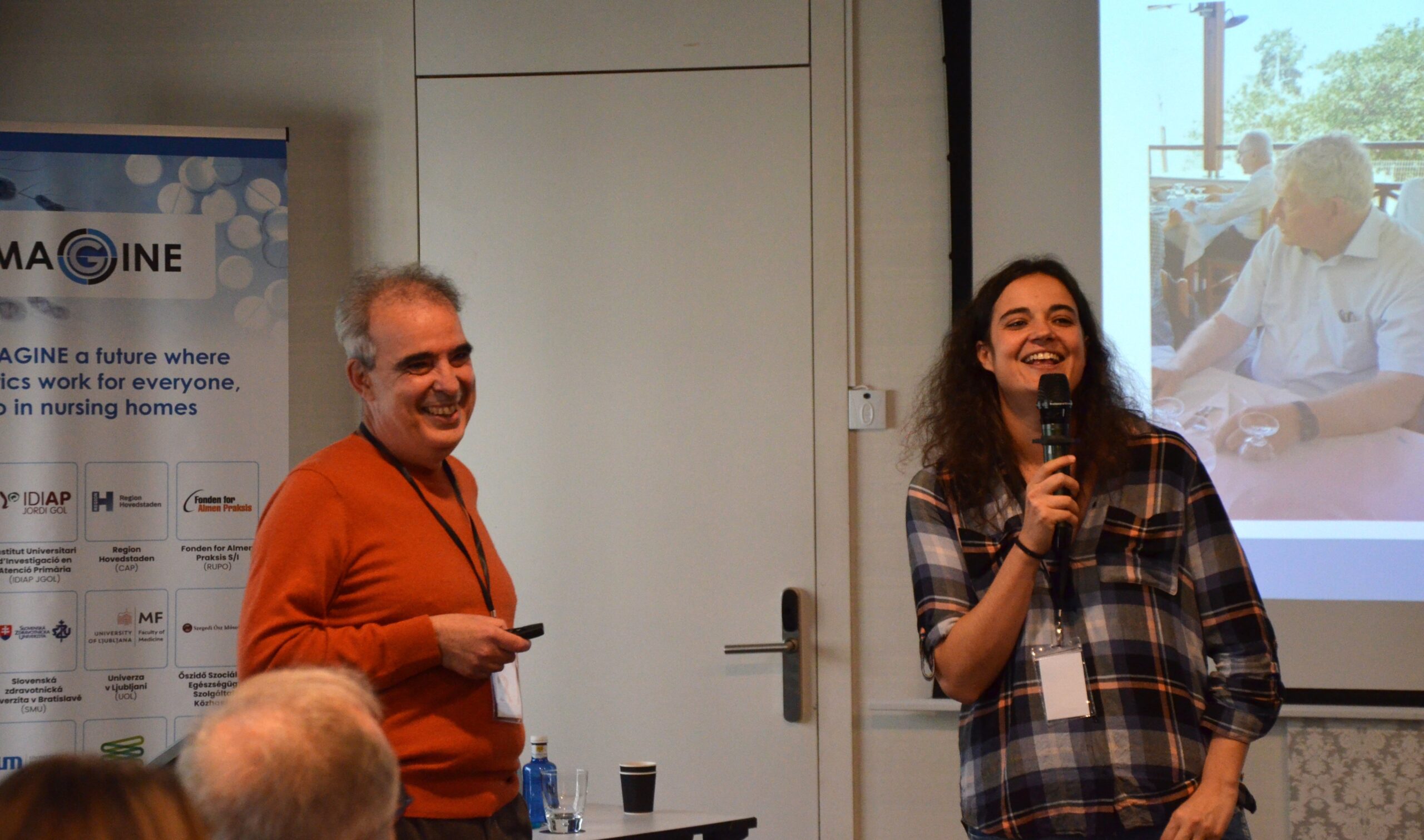
Barcelona hosted the final conference of the IMAGINE Project, which over three years evaluated the effectiveness of preventive interventions in more than one hundred nursing homes and long-term care centers across eight European countries to reduce antimicrobial resistance through more rational use of antibiotics. During the event, held on December 12, 2025, the project results were presented, showing a 27% reduction in urinary tract infections and an improvement in antibiotic prescribing.
The conference was attended by consortium members, representatives of the participating countries, and several European Commission officials, who shared project experiences and presented its main outcomes after three years of collaborative work to reduce antibiotic resistance in Europe.
The event was chaired by Ana García Sangenís, research manager at IDIAPJGol.
The opening session featured Carl Llor, researcher at IDIAPJGol and project coordinator; Julia Langer, Policy Officer at the European Commission’s Directorate-General for Health and Food Safety (DG SANTE); Marc Vandenbroeck, Project Manager at HaDEA (European Commission); Elisabet Descals, Primary Care Manager at ICS; and Josep Basora, Director of IDIAPJGol.
Carl Llor emphasized the need to promote “coordinated and evidence-based actions to combat antimicrobial resistance, especially in vulnerable settings such as nursing homes,” while Julia Langer highlighted that “antimicrobial resistance is a priority public health challenge for the European Union” and outlined key European strategies and funding instruments aimed at reducing antibiotic use. In this context, Marc Vandenbroeck stressed the role of the EU4Health program in supporting initiatives like IMAGINE and encouraged the consortium to “continue developing joint actions aligned with European priorities.”
Elisabet Descals and Josep Basora expressed their gratitude for the work carried out by the IMAGINE Project and encouraged continued efforts in this key public health area.
Results
During the results presentation, Carl Llor explained the origins and motivations of the IMAGINE Project, which arose from the observation that measures to combat antimicrobial resistance, particularly in southern Europe, were insufficient. It is estimated that between 30% and 80% of antibiotic treatments in European nursing homes are unnecessary or inappropriate.
In response to this situation, the project focused on nursing homes and urinary tract infections, one of the main reasons for antibiotic prescribing in these settings.
Llor highlighted the simplicity and practicality of the analyses conducted, as well as the high level of engagement of participating professionals and the ability of the interventions to adapt to the realities of each country.
The study evaluated the effectiveness of several preventive interventions organized into different “work packages.” Among these methodological resources, the APO approach (Audit and Feedback for Practice Optimization) stood out, allowing two audits using a simple, voluntary paper-based registry, which facilitated high participation from healthcare professionals in over 100 nursing homes. The IPC methodology (Infection Prevention and Control) was also presented, developed collaboratively with participants through a Participatory Action Research process, resulting in 29 key elements to record on paper, to support daily practice and focus efforts on concrete improvement actions.
The actions promoted by the IMAGINE Project produced significant results: nearly 60% of infection prevention and control measures improved, unnecessary antibiotic prescriptions decreased by 13%, and the incidence of urinary tract infections treated with antibiotics fell by 27%.
Regarding cost-effectiveness, Laura Vallejo, researcher at the University of Las Palmas de Gran Canaria, highlighted that IMAGINE interventions proved to be cost-effective, with a high probability of generating savings for health and social care systems in most of the eight participating countries. If implemented across Europe, the extrapolated results suggest potential savings of up to €150 million annually, with an estimated return of four euros saved for every euro invested.
Experiences from the eight participating countries
The IMAGINE Project involved eight European countries: Spain, Denmark, Greece, Lithuania, Poland, Slovakia, Hungary, and Slovenia. The event concluded with presentations from representatives of each country, who shared their national experiences and results, as well as areas identified for future improvements.
In Spain, Ramon Monfà, researcher at IDIAPJGol, detailed the development of the methodology for selecting nursing homes and the training workshop for nursing home staff.
Finally, all participants expressed their gratitude for being part of the IMAGINE Project and highlighted their high satisfaction with the process and outcomes achieved.