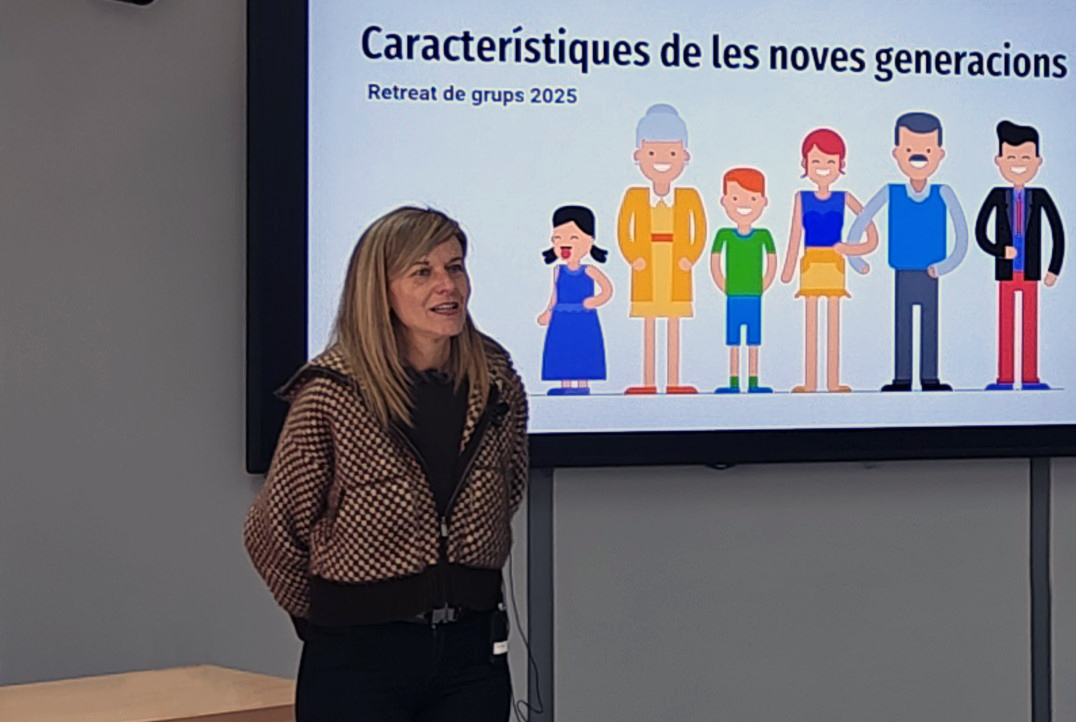
The Deputy Director of IDIAPJGol, Anna Berenguera, gives a very positive assessment of the Institute’s second groups’ retreat, held on 19 November 2025 at the Badalona International Business Centre (BCIN). During the meeting, participants discussed how to improve collaboration between research groups, a topic already addressed at the previous retreat, and the challenge posed by generational turnover among principal investigators. Regarding the first issue, Berenguera highlights that collaboration and relationships between groups and territories have increased considerably since the previous meeting, especially between the groups of the Transversal Research Unit and the rest. With respect to generational turnover, she believes it is a challenge that must be approached from different angles: making the most of the knowledge of researchers who are retiring, ensuring the continuity of research lines and identifying new emerging ones, and motivating healthcare professionals to engage in research.
This was the second groups’ retreat of IDIAPJGol, after the one held in 2023. What has changed compared with the previous meeting?
At the first retreat we focused on collaboration and relationships between groups. A product emerged from that process: the code for collaboration between groups, which yielded very positive results. In 2025 we revisited the issue of inter-group relationships which, despite the improvements achieved, still need strengthening. However, we mainly focused on generational turnover. More than 39 % of the principal investigators of IDIAPJGol’s 41 research groups are over 60 years old. As an institution, we are implementing actions to mitigate this situation, such as the Barbara Starfield Award call, which allows consolidated groups to incorporate a PhD candidate with international projection; we have developed an academic research career pathway, and we collaborate with the SEMFyC’s end-of-residency awards. Even so, some groups are left orphaned because there is no junior researcher ready to take over from a PI who is about to retire.
Besides the principal investigator, is the rest of the research staff in the groups also older?
There is a bit of everything; it depends a lot on the group. What is true is that PIs are people with very strong experience: they lead collaborative networks, participate in national and international research projects, have solid methodological expertise, and have accumulated extensive scientific evidence. It is important that all this knowledge and these relationships are not lost when the principal investigator retires. One way to prevent this is to bring in younger researchers as co–principal investigators five or ten years before the PI retires. This makes the transition smoother. With proper support, the changeover is less abrupt. At the retreat, we discussed common strategies that will be formalised in a document.
Some investigators have told that it is difficult to motivate young healthcare professionals to do research because culturally they prioritise other things. Do you share this perception?
Healthcare professionals who want to do research must find time outside their working hours, and this is difficult. We need people with curiosity, a need to investigate, to improve clinical practice… These people already exist, but we must motivate them to join research groups. This is the idea behind the Barbara Starfield scholarships, but there is also a more structural issue: enabling primary care professionals to do research, because often doing research after a full day of clinical work is an act of heroism.
Apart from the initiatives we are implementing at IDIAP to help researchers free up time from clinical duties to conduct research, what other activities could be done?
It is important to make the most of the requests received by the local Research Support Unities to attract and retain professionals, and to offer them the possibility of being relieved of duties so they can develop research projects and join the groups coordinated by the Research Support Unities.
Is the generational turnover issue a structural problem specific to IDIAPJGol, or does it affect all research centres?
It is general. In fact, in this area we are doing better than others. Everywhere there is a strong dependency on principal investigators, who are ageing. We should be able to act proactively and implement mentoring initiatives, as is done in some European countries where professionals retire earlier. Here, some PIs retire at 65 or 70, and we start acting when they are 60, whereas we should do so earlier. Especially with these mentoring actions and supporting younger researchers to take over. It is important to give visibility to sub-lines that may emerge within groups.
The other key topic of the retreat was collaboration between groups. How do you see the current situation?
We created a map showing relationships between groups, which reveals many more collaborations than in the previous retreat. Now everyone is clear about what the others are doing. There were also groups with very similar research sub-lines that have now been divided between them. We want to continue improving these relationships. Territories still tend to work endogenously, but considerably less so than two years ago.
Was the work done at the previous retreat to strengthen collaboration positive?
Yes, the groups located in the Transversal Research Unit now collaborate much more with other groups and territories; in fact, this is their main purpose. The AGAUR research group call also encourages groups to join forces to meet the requirements.
The mental health group is an example of two groups from two different territories merging into one. Are there other cases that could be replicated?
Now there are no others, but more will be needed because some groups have similar research lines that could merge, especially in the area of primary care services research, which ends up being a miscellany of different lines and sub-lines that should be grouped and reorganised. We are currently organising the work into major hubs: mental health, primary care services, prevention and ageing, and chronic diseases… These are major areas in which we must define the research lines they encompass, and this is work we must carry out in the coming months.
What results do you expect after this retreat?
I hope the discussions we have had will materialise into strategies and challenges that will improve generational turnover and collaboration between groups and territories, ultimately leading to more competitive primary care research.